
Low Noise RF Amplifier
4.2Editor score
0.1 to 2000MHz Coverage
32dB Gain Low Noise
9 to 12V DC Power
This guide compares the top ten Ham Radio Amplifier for Boosting Signal options available today to help you choose the right model for your station needs.
Finding the right Ham Radio Amplifier for Boosting Signal can transform your communication experience. Whether you are a hobbyist or a professional operator, signal clarity matters. The market offers many choices ranging from simple preamps to powerful linear amplifiers.
We analyzed ten distinct products based on their technical specifications, user feedback, and intended applications. Our comparison covers frequency ranges, power output, cooling systems, and compatibility with various transceivers to ensure you find a reliable match.
Each selection below highlights key features and potential limitations to guide your decision. Prices fluctuate often so check current listings before purchasing. We aim to provide clear insights so you can invest confidently in your radio equipment.
4.2Editor score

4.2Editor score

5.0Editor score
The following table provides a side-by-side overview of each amplifier model. It highlights key specifications such as frequency coverage, gain levels, and power requirements to help you compare features quickly.



The Xiegu GPA100 stands out as a top choice for operators needing reliable amplification. It offers 100W power across HF and 6m bands with low distortion. Its linear design ensures clear signal purity even during long transmissions.
We may earn a commission when you buy through this link, at no additional cost to you.
This amplifier features flexible band switching with manual or auto modes. The built-in Bluetooth allows wireless control for the IC-705 without extra cables. It detects and protects against issues like overheating or high SWR.
While the unit is robust, it requires a compatible transceiver for optimal use. Some users might find the cost higher than simpler preamps. However, the efficiency and safety features justify the investment for serious operators.
Ham radio enthusiasts looking to expand their QRP setup should consider this model. It transforms low-power radios into powerful stations effortlessly. The intelligent control system ensures safe operation during extended use.
Bluetooth connectivity eliminates cables for band tracking on supported radios.
Internal sensors detect overheating and high SWR to prevent damage.
We may earn a commission when you buy through this link, at no additional cost to you.
This Low Noise RF Amplifier provides excellent value for those needing broad frequency coverage. It operates from 0.1MHz to 2000MHz covering shortwave FM and VHF signals. The 32dB gain helps boost weak reception effectively.
We may earn a commission when you buy through this link, at no additional cost to you.
It consumes only 27mA making it ideal for portable field use. The 9 to 12V DC input works with standard lithium batteries. It is designed for receiving front-end applications to improve communication distance.
The unit is best for receiving rather than high-power transmitting. Users seeking cheap signal boosts will appreciate its reliability. It fits well in DIY projects or simple antenna systems.
Amateur radio operators and shortwave listeners can benefit from this amplifier. It increases signal quality without high costs. Check the voltage requirements to ensure compatibility with your setup.
Handles signals from 0.1MHz to 2000MHz for diverse applications.
Low current draw allows use with portable power sources.
We may earn a commission when you buy through this link, at no additional cost to you.
The RF Wideband LNA Amplifier delivers high performance for diverse radio tasks. It covers 10MHz to 6GHz supporting FM SDR and ham radio signals. The 30dB gain maintains clear reception with low noise.
We may earn a commission when you buy through this link, at no additional cost to you.
Its compact aluminum case fits neatly into test setups. The Type C 5V power makes installation simple for modern users. It integrates easily with compatible cables and RF devices.
While the cost is higher than simpler models the build quality justifies it. It is suitable for setups needing dependable signal handling. Users appreciate the wide working frequency span.
Technicians and ham radio operators will find this module useful. It strengthens weak signals efficiently without complex wiring. Ensure your power supply matches the 5V Type C requirement.
Type C 5V input simplifies connection to portable devices.
30dB gain improves signal strength while reducing noise.
We may earn a commission when you buy through this link, at no additional cost to you.
This LNA amplifier is designed to enhance the TinySA Ultra or SDR receiver. It offers a 100k to 10GHz range for ultra-broadband detection. The 21dB gain makes faint signals clearly visible.
We may earn a commission when you buy through this link, at no additional cost to you.
It includes a 300mAh battery for up to five hours of operation. This eliminates the need for USB power banks during field tests. The metal housing provides shielding against interference.
Users should avoid using it in noisy environments to prevent overload. Some ratings indicate it may not be suitable for high-interference areas. It works best for outdoor antenna tuning.
Engineers and hams needing portable tools will appreciate this design. It is an essential component for weak-signal DXing. Ensure you follow usage guides to protect your receiver.
Integrated 300mAh battery allows untethered field testing.
Improves TinySA receiver sensitivity for distant signals.
We may earn a commission when you buy through this link, at no additional cost to you.
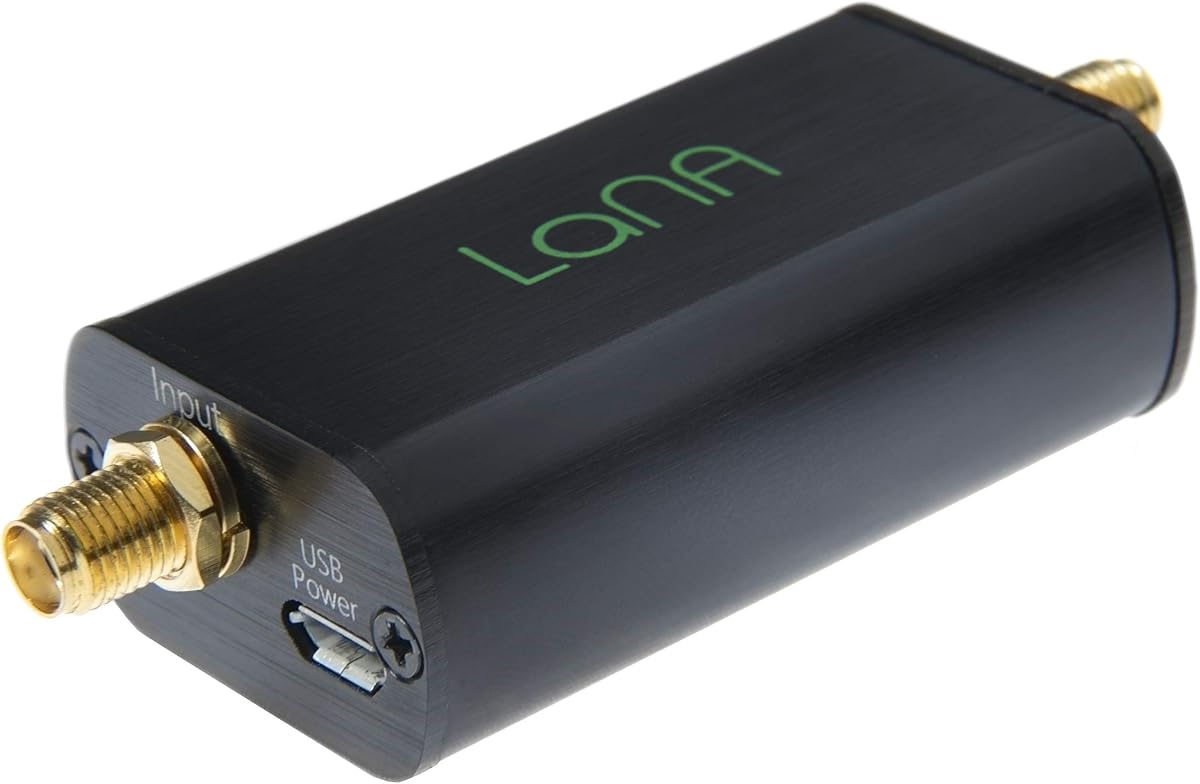
The Nooelec Lana module is a reliable choice for RTL-SDR and other radios. It covers 20MHz to 4000MHz with an extremely low noise figure. It improves SNR and linearity compared to similar modules.
We may earn a commission when you buy through this link, at no additional cost to you.
Users can power it through bias tee USB or DC with the adapter. The included male SMA to SMA connector aids setup. It helps strengthen signals in high-quality aluminum housing.
Some SDRs may need a DC block between LNA and receiver. This adds a step for users unfamiliar with RF setups. The performance benefits outweigh this minor complexity.
SDR enthusiasts looking for performance boosts should consider this module. It is general purpose and fits many configurations. Check your SDR power options before installing.
Works with bias tee USB or DC power via adapter.
Ultra low noise figure improves overall signal clarity.
We may earn a commission when you buy through this link, at no additional cost to you.
The Generic Taurus MK2 is a new wideband pre-amplifier designed for scanners. It operates from 25 to 2000MHz with 6 to 20dB gain. This covers standard scanner frequencies for improved signal reception.
We may earn a commission when you buy through this link, at no additional cost to you.
It runs on a PP3 battery making it easy to deploy. The package includes a BNC patch lead for quick setup. Its simplicity makes it accessible for casual users.
While effective for scanners it may lack features for advanced users. The adjustable gain helps optimize performance across bands. It is a straightforward solution for signal needs.
Scanner operators looking for an affordable booster should check this. It improves reception on any scanner receiver. Ensure you have the correct battery for continuous use.
Optimized for 25 to 2000MHz frequency range.
Runs on standard PP3 battery for portable use.
We may earn a commission when you buy through this link, at no additional cost to you.
The BJ-300 Plus supports multiple modulation modes with high power. It delivers up to 100W FM 120W AM and 150W SSB output. This extends communication range for reliable long-distance operations.
We may earn a commission when you buy through this link, at no additional cost to you.
It works with HF transceivers requiring 3-5W or 2-10W input. The high-efficiency cooling fan and heat sink prevent overheating. It includes polarity reversal protection and fuses for safety.
While ratings are moderate it offers practical controls and connectors. Users appreciate the simple mode selector and power switches. It suits both new and experienced users for setup.
Radio operators needing high power in a compact design should consider this. It offers versatility for CB and ham radio. Ensure you match input power requirements before use.
Supports AM FM SSB and CW for versatile use.
Cooling fan and heat sink maintain stable operation.
We may earn a commission when you buy through this link, at no additional cost to you.
This LNA module covers a frequency range from 100kHz to 10GHz. It offers 21.5dB gain at 10MHz with good flatness. Users see obvious noise floor improvement compared to regular USB LNA modules.
We may earn a commission when you buy through this link, at no additional cost to you.
It is powered via USB with 52mA current draw. It is ideal for TinySA ULTRA high-frequency testing since onboard LNA works below 3.5GHz. It replaces ADM-8095 modules easily.
The metal housing is shielded to protect against interference. Users must avoid excessive input power to prevent saturation. Keeping it dry is key for long-term reliability.
Engineers using TinySA ULTRA for tests will find this valuable. It improves high-band receiving and measuring. Ensure you follow environmental tips for outdoor applications.
USB powered with 52mA for easy portable setups.
Built-in LDO suppresses power supply noise effectively.
We may earn a commission when you buy through this link, at no additional cost to you.
This amplifier supports multiple modes with high output power. It delivers up to 100W FM 120W AM and 150W SSB. It extends communication range for reliable long-distance operations.
We may earn a commission when you buy through this link, at no additional cost to you.
It is compatible with most HF transceivers requiring low input. The cooling fan and heat sink ensure stable performance during use. Safety features include electronic polarity reversal protection.
Controls are simple with mode selector and power switches. Connectors are standard PL-259 for quick installation. This suits both new and experienced users for setup.
Operators needing reliable high power should consider this unit. It balances simplicity with high performance. Ensure you check input power before connecting to transceivers.
Works with most CB radios and HF transceivers.
Protection from surges and incorrect connections included.
We may earn a commission when you buy through this link, at no additional cost to you.
The BJ-300 delivers up to 150W SSB output power. It supports AM FM SSB and CW modes for radio and ham applications. This makes it suitable for reliable signal amplification across frequencies.
We may earn a commission when you buy through this link, at no additional cost to you.
It has a HI/LO power selection switch to adjust output strength. Electronic switch and polarity inversion protection ensure stable operation. The compact aluminum heat sink aids heat dissipation.
Standard antenna and transceiver ports allow quick installation. Users benefit from the practical design and overvoltage safety. It offers a balance of compact size and performance.
Transceiver users needing a compact booster should consider this model. It supports multiple modulation modes effectively. Ensure you check current input requirements before purchase.
HI/LO switch lets you adjust output strength easily.
Aluminum alloy heat sink construction ensures efficient cooling.
We may earn a commission when you buy through this link, at no additional cost to you.
Selecting the right amplifier involves understanding key technical requirements. Below are important factors to consider for your radio station.
Ensure the amplifier supports your target frequencies like HF VHF or UHF. Some models cover narrow bands while others span from MHz to GHz for versatility. Check if your signals fall within the stated operating range before buying.
Always verify the range matches your specific radio needs.
Gain determines how much the signal is amplified often measured in dB. Output power in watts affects how far you can transmit. Higher gain helps weak reception while higher output extends communication range.
Balance gain with your required power output.
A low noise figure ensures weak signals are not buried by static. Linearity preserves signal purity especially for digital modes or SSB. Poor linearity can distort signals and cause interference.
Look for low noise and high linearity ratings.
Amplifiers generate heat during operation which can damage components. Models with fans or heat sinks prevent overheating during extended use. Thermal protection circuits shut down the unit if it gets too hot.
Prioritize units with active or passive cooling systems.
Check if the amplifier requires DC voltage USB or battery power. Some units work with standard 13.8V supplies while others use Type C. Ensure your power source matches the amplifier requirements.
Confirm voltage and current limits for your power source.
Connectors like SMA BNC or PL-259 must match your existing cables. Some models offer Bluetooth or USB interfaces for control and monitoring. Compatibility reduces extra adapters and simplifies setup.
Match connectors to your current radio and antenna setup.
Look for polarity reversal overcurrent and overvoltage protection. These safeguard the amp and your radio from electrical surges or wrong connections. Built-in fuses and safety switches add reliability.
Ensure robust protection mechanisms are included.
Aluminum or metal housings protect against interference and physical damage. Compact designs are better for field work while heavy units suit fixed stations. Durability ensures long-term performance.
Choose a build quality that fits your usage location.
Start by connecting the amplifier between your transceiver and antenna using the correct cable type. Ensure all connectors are tight to prevent signal loss or interference.
Power up the unit according to the manufacturer instructions. If using a battery check voltage levels before use. Allow the cooling fan to run during transmission to avoid overheating.
Regularly inspect cables and connectors for wear. Store the unit in a dry place to prevent corrosion. Follow protection guidelines to avoid overloading the amplifier during testing.
It is a device that increases signal strength for radio transmission or reception. It improves communication range and clarity for amateur and professional use.
Match the amplifier range to your operating bands. HF models cover shortwave while wideband covers MHz to GHz. Verify your signals fall within the specs.
Not always. Excessive gain can cause overload or distortion. Balance gain with signal conditions to ensure clear reception without noise.
Most require DC 12V or USB. Check input specs to ensure your power source matches voltage and current requirements.
They generate heat during operation. Cooling prevents overheating and ensures stable performance during extended use.
Yes many models support SDR with USB power. Ensure the frequency range and gain match your software-defined radio needs.
Yes they safeguard equipment from electrical faults. Polarity and overvoltage protection add reliability to your setup.
Connect it between the antenna and receiver. Use short cables to minimize loss. Ensure the connectors match your existing equipment.
We reviewed ten amplifiers from portable LNAs to powerful linear units. Each offers unique benefits for different needs and budgets.
Prioritize frequency range and power output to match your station setup. Ensure safety features and connectors are compatible with your existing gear.
Prices and stock change so verify current listings before purchasing. Use this guide to find the right amplifier for your radio goals.