
KK 2.1.5 Flight Control Board
5.0Editor score
VTOL and V-Tail Support
Self-Balancing Aerobatics
Affordable Hobbyist Option
This guide compares ten top flight controllers for Hybrid Vtol and Vtol Drones, examining processors, firmware support, and stability features.
Choosing the right flight controller for hybrid VTOL and VTOL drones requires careful consideration of processing power, firmware compatibility, and sensor accuracy. These devices serve as the brain of your aircraft, managing complex transitions between vertical takeoff and fixed-wing flight modes seamlessly.
We evaluated ten leading controllers based on processor architecture, supported flight stacks, sensor redundancy, and overall build quality. Our analysis focuses on models that offer robust performance for both hobbyist builds and professional autonomous vehicle applications across diverse mission profiles.
Each pick highlights unique strengths like open-source flexibility, dual IMU redundancy, or compact stack designs. Prices and availability change frequently so always verify current details before purchasing to ensure you get the best value for your specific drone project needs today.
5.0Editor score
4.8Editor score

4.5Editor score
This side-by-side comparison breaks down the key specifications of each model including processor type, sensor suite, and firmware support to help you decide quickly.



The KK 2.1.5 stands out as a reliable option for those needing a simple controller that supports VTOL and V-tail configurations. With a perfect rating from users it delivers stable flight performance for competitions and photography projects without complexity.
We may earn a commission when you buy through this link, at no additional cost to you.
Its advanced flight control technology ensures smooth transitions between modes making it suitable for challenging maneuvers. The self-balancing feature helps maintain stability even in less controlled environments which is crucial for outdoor flying sessions.
While it lacks modern high-speed telemetry interfaces the simplicity is a trade-off many hobbyists appreciate. This design keeps weight low and setup time short allowing you to focus more on flying skills than wiring diagrams.
This controller is ideal for enthusiasts seeking customizable features without a steep learning curve. Whether you are building a new drone or upgrading an older one the KK 2.1.5 offers dependable performance for varied flight occasions.
The integrated self-balancing system ensures that your aircraft remains level even during unexpected wind gusts.
From aerial photography to skill showcasing this board adapts to multiple project types with minimal configuration changes.
We may earn a commission when you buy through this link, at no additional cost to you.
The COREWING F405 V2 offers a compelling solution for builders who want a single controller for both fixed wing and multirotor applications. Its F405 processor ensures that it keeps pace with modern firmware requirements for efficient flight management.
We may earn a commission when you buy through this link, at no additional cost to you.
Designed to fit a variety of frames this controller balances performance with size effectively. The ability to switch between aircraft types without changing hardware makes it a flexible choice for evolving project needs.
Some users may find the initial setup requires careful reading of available documentation. However once configured the system provides stable flight characteristics suitable for both cruising and more aggressive maneuvering.
This board is recommended for pilots who value versatility and raw processing power in a small package. It serves as a strong foundation for custom builds that need to handle diverse mission profiles efficiently.
Supporting both airplanes and drones allows you to maintain a single hardware ecosystem for multiple aircraft projects.
The F405 core handles complex control loops with ease ensuring smooth transitions and responsive handling.
We may earn a commission when you buy through this link, at no additional cost to you.
The PIX 2-12S is engineered for demanding applications where high voltage power systems and precise sensor data are required. It supports up to 12S input making it a robust choice for larger VTOL and multirotor configurations.
We may earn a commission when you buy through this link, at no additional cost to you.
Integrated sensors like the MPU6500 gyroscope and LPS22HB barometer provide the accuracy needed for stable flight. The variety of receiver inputs including SBUS and PPM ensures compatibility with most modern radio systems.
While the board is compact at 39x39mm it delivers professional-grade performance for DIY autonomous driving and flight systems. However the advanced features come with a learning curve that may deter casual hobbyists.
This controller is best suited for serious builders who need to integrate complex sensor suites and high power ESCs. Its versatility in both flight and roaming vehicle applications makes it a standout for advanced custom projects.
The 12S support allows for larger batteries which extend flight time without compromising on power delivery.
Multiple integrated sensors ensure precise altitude and orientation data even during complex autonomous maneuvers.
We may earn a commission when you buy through this link, at no additional cost to you.
The Pixhawk 2.4.8 is a cornerstone of the open source flight controller world offering robust performance across fixed wing and multirotor platforms. It is often the first choice for researchers and developers needing a reliable base for customization.
We may earn a commission when you buy through this link, at no additional cost to you.
Its high-end configuration includes a 32-bit fail-safe co-processor and advanced accelerometer ensuring safe operations. The open nature of the firmware allows for extensive modifications to meet specific mission requirements.
New users might find the assembly process slightly involved but quick start guides are available to assist. The quality assurance process ensures that each unit is inspected before shipment providing peace of mind for critical missions.
This controller is perfect for anyone looking to dive into autonomous flight development or academic research. Its versatility in supporting various vehicles from boats to cars makes it a powerful tool for complex engineering projects.
The open codebase allows you to tailor the autopilot logic to fit exact project specifications without restriction.
Support for multiple vehicle types means you can use one controller platform for different autonomous systems.
We may earn a commission when you buy through this link, at no additional cost to you.
The F405 Wing Flight Controller is tailored for fixed wing drones with VTOL capabilities offering a streamlined experience for users. Support for Ardupilot firmware ensures advanced customization while the APP control feature simplifies monitoring and configuration tasks.
We may earn a commission when you buy through this link, at no additional cost to you.
Its design focuses on minimizing added weight while maintaining robust functionality which is crucial for flight efficiency. The F405 processor ensures fast and stable processing for smooth flight experiences during complex transitions.
Users of all skill levels can benefit from the user-friendly setup and extensive features. The lightweight compact design makes integration into various fixed wing models flexible and relatively straightforward.
This board is an ideal choice for those who prioritize easy monitoring and reliable VTOL performance. Whether for beginner projects or experienced builds it offers a balanced solution for modern drone architecture.
Smartphone control allows for quick parameter changes and real-time status checks without a laptop.
The firmware is specifically tuned for the unique aerodynamics of fixed wing drones with VTOL capabilities.
We may earn a commission when you buy through this link, at no additional cost to you.
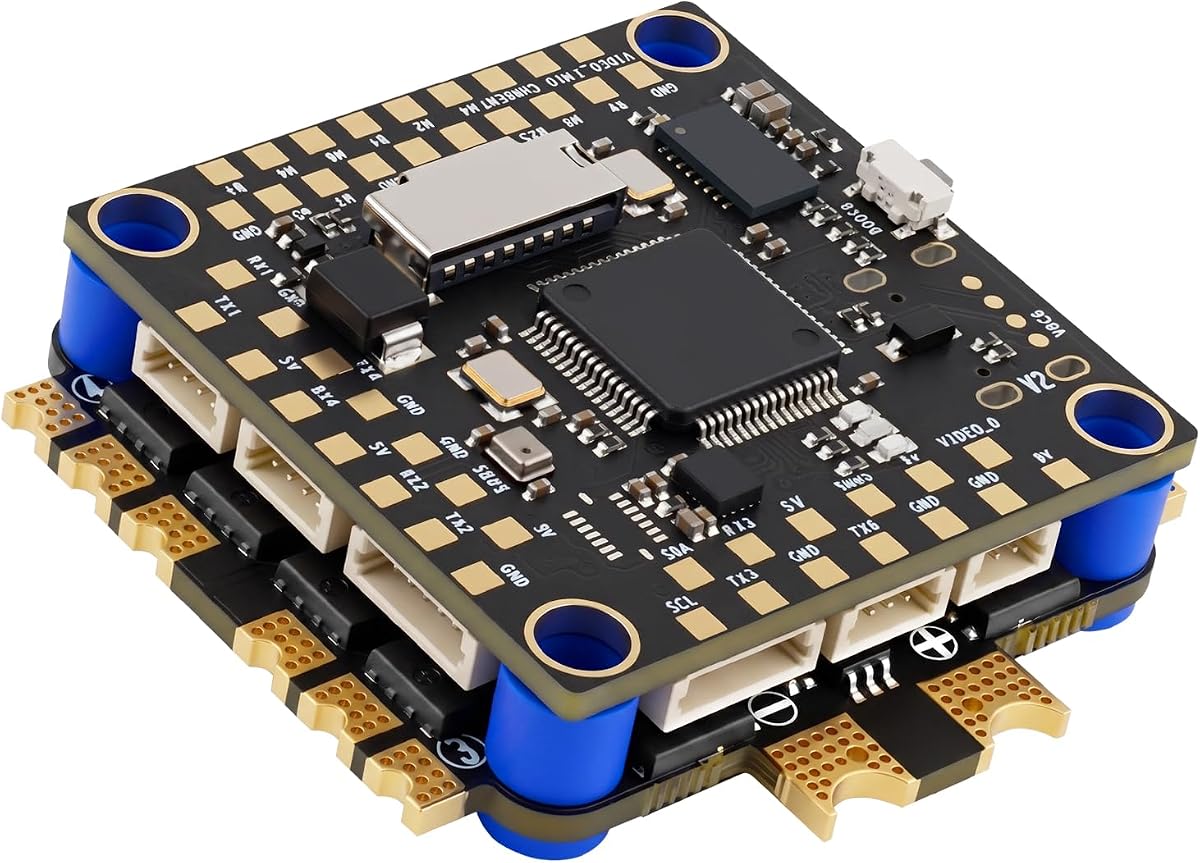
This stack features the CORVON H743 controller paired with a 60A ESC providing a reliable combination for high-performance builds. The 480MHz processor and dual IMUs ensure superior control accuracy which is vital for racing and FPV applications.
We may earn a commission when you buy through this link, at no additional cost to you.
Compatibility with Betaflight INAV PX4 and Ardupilot offers great flexibility for different mission types. The support for 2S to 8S LiPo batteries covers a wide range of power needs making it adaptable to various frame sizes.
The 30×30 stack design fits standard frames while offering extensive expansion potential with 7 UART ports and CAN bus support. This makes it a strong option for complex builds requiring GPS telemetry or camera peripherals.
It is a perfect choice for pilots who need raw power and connectivity in a compact package. The balanced design and high current output ensure optimal power responsiveness and stalling protection during intense maneuvers.
With multiple UART ports and CAN bus support adding peripherals like GPS and cameras is straightforward.
Supporting four major flight stacks allows you to switch configurations based on your current project needs.
We may earn a commission when you buy through this link, at no additional cost to you.
The H743 50A stack offers a lightweight solution for FPV and racing drones with dual IMUs and a high-performance processor. It supports 2S to 6S LiPo batteries which is sufficient for many standard racing frames without excess weight.
We may earn a commission when you buy through this link, at no additional cost to you.
Firmware support spans Betaflight INAV PX4 and Ardupilot providing the flexibility needed for various flight styles. The compact design simplifies assembly and ensures efficient space management within tight drone frames.
While it is slightly lighter than its 80A counterpart it still delivers high-frequency PWM and DSHOT protocols for precise throttle response. The inclusion of an OSD and CAN bus allows for detailed telemetry and peripheral integration.
This stack is ideal for pilots who prioritize agility and responsiveness in their builds. The balanced performance and connectivity options make it a versatile choice for both beginners and professionals alike.
High-frequency PWM protocols ensure that motor response is immediate and smooth during critical flight moments.
At just 21.5g the entire stack adds minimal weight which preserves flight time and agility.
We may earn a commission when you buy through this link, at no additional cost to you.
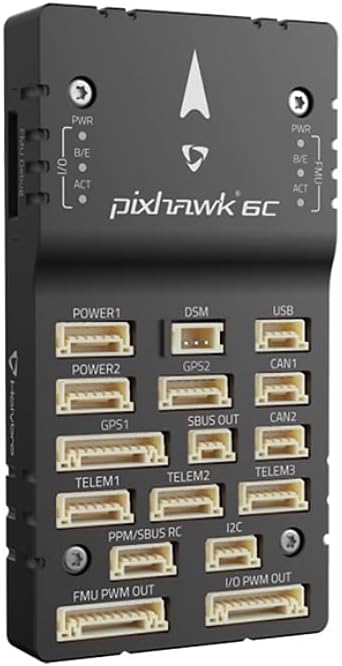
The Pixhawk 6C stands as a high-performance option with dual redundant IMUs and an integrated vibration isolation system. Its STM32H743 processor delivers massive computing power required for complex autonomous vehicle algorithms and research applications.
We may earn a commission when you buy through this link, at no additional cost to you.
Features like onboard heating resistors ensure the IMUs work at optimum temperature for unmatched reliability in varying environments. The vibration isolation system effectively filters out high-frequency noise to guarantee precise sensor readings and stable flight.
It is pre-installed with PX4 Autopilot and supports ArduPilot making it versatile for academic and commercial use. The low profile form factor makes it suitable for both research and professional autonomous vehicle applications.
This controller is perfect for developers who need industrial-grade reliability and sensor redundancy. The combination of advanced isolation and powerful processing makes it a top choice for critical mission profiles.
Dual IMUs from Bosch and InvenSense ensure that one sensor failure does not compromise the entire flight.
Integrated isolation reduces motor noise so that flight data remains clean even during high thrust maneuvers.
We may earn a commission when you buy through this link, at no additional cost to you.
This stack offers a reliable combination for lightweight builds with a budget-friendly F405NC controller and a 45A ESC. The dual IMUs and DPS310 barometer provide solid performance for FPV and racing applications where cost efficiency matters.
We may earn a commission when you buy through this link, at no additional cost to you.
Compatibility with Betaflight INAV and ArduPilot ensures you have the flexibility to choose the best firmware for your needs. The lightweight design fits a wide variety of frames and simplifies installation significantly.
While the ESC is rated at 45A continuous it delivers enough power for most racing builds without breaking the bank. The inclusion of OSD and multiple UART ports allows for essential telemetry and peripheral connections.
It is a great choice for pilots who need a balance of performance and affordability. The stack provides all the essential features required for high-performance racing drones without unnecessary cost.
You get all the necessary features for racing without the premium price tag of high-end stacks.
Dual IMUs and a dedicated barometer ensure stable hover and accurate altitude data.
We may earn a commission when you buy through this link, at no additional cost to you.
The AERO SELFIE H743 stack brings high performance to racing drones with a powerful processor and a 60A 32 bit ESC. It supports a wide range of firmwares including Betaflight PX4 INAV and ArduPilot for maximum flexibility.
We may earn a commission when you buy through this link, at no additional cost to you.
The stack includes a compass and barometer for enhanced flight stability and navigation. Its compact design ensures easy installation while providing vast expansion potential for telemetry and camera peripherals.
With 7 UART ports and CAN bus support it offers excellent connectivity for future upgrades. The lightweight construction helps maintain flight time while delivering responsive motor control and stalling protection.
This stack is recommended for pilots who want advanced connectivity without sacrificing compactness. It offers a robust set of features that make it a strong candidate for complex racing and FPV builds.
The 480MHz H743 processor ensures that complex flight calculations are handled instantly.
CAN bus and I2C support allow for advanced sensor and peripheral integration easily.
We may earn a commission when you buy through this link, at no additional cost to you.
Selecting the right flight controller involves weighing processing power, firmware support, and sensor redundancy to match your specific mission profile.
The processor is the brain of your drone. Modern controllers often use STM32F405 or H743 chips which offer high clock speeds and processing power. Look for processors that can handle complex flight algorithms without lag ensuring smooth transitions between VTOL modes.
Prioritize newer generation chips like the H7 series if you plan to use advanced features or heavy telemetry.
Your controller must support the firmware you plan to use such as ArduPilot PX4 or Betaflight. Check compatibility lists to ensure it supports VTOL specific modes and autonomous features. Open source firmware often provides the most flexibility for custom builds.
Verify that the firmware community is active so you get regular updates and support for your specific project.
For reliable VTOL flights sensors like accelerometers gyroscopes and barometers are critical. Look for controllers with dual IMUs to prevent failure if one sensor malfunctions. High quality sensors reduce noise and improve flight stability.
Sensors that are vibration isolated or temperature controlled provide better data in extreme environments.
Consider the voltage and current requirements of your motors. Controllers that support higher voltages like 6S or 12S offer more flexibility for larger batteries. Integrated ESC stacks can reduce wiring complexity but standalone controllers offer more upgrade paths.
Ensure the ESC supports modern protocols like DSHOT for precise motor control.
A good controller should have enough UART ports for GPS radios and telemetry modules. CAN bus and I2C support allow you to add advanced sensors without cluttering the main board. Check for available GPIO pins if you plan to add custom peripherals.
More ports mean more flexibility for future upgrades as your project evolves.
VTOL drones often have strict weight limits for efficient flight. Compact boards like the 30×30 stack design fit easily into standard frames while providing robust features. Lighter boards help preserve flight time and maneuverability.
Check mounting hole patterns to ensure they match your frame design for easier installation.
Vibrations from motors can degrade sensor data and lead to flight issues. Look for controllers with built-in vibration isolation or rubber mounts. This feature is essential for VTOL drones where propeller wash and motor noise are significant.
Proper mounting with dampeners will improve overall flight smoothness and sensor accuracy.
Even the best hardware needs good support. Check if there are active forums or documentation available for the controller. A strong community means easier troubleshooting and more configuration examples.
Prioritize brands that offer regular firmware updates and responsive support channels.
Always calibrate your IMUs and barometers on a level surface before each flight to ensure accurate data. Use software tools to verify that all connected peripherals like GPS and ESCs are communicating correctly.
Secure your controller with rubber grommets to reduce vibration from motors and propellers. This simple step protects sensitive components and improves long-term reliability of your drone.
Keep the firmware updated regularly to benefit from bug fixes and new features. However always test updates in a safe environment before flying in critical conditions.
Hybrid VTOL controllers are designed to manage both vertical takeoff and fixed wing flight modes efficiently. They include specific firmware that handles the transition between hover and forward flight seamlessly.
Dual IMU redundancy is crucial for safety as it allows the system to switch to a secondary sensor if the primary one fails. This prevents sudden crashes due to sensor malfunctions during flight.
Yes Betaflight supports some VTOL modes but ArduPilot or PX4 often provide more robust features for fixed wing transitions. Choose the firmware that best matches your specific aircraft design.
A GPS module is highly recommended for VTOL flights especially for autonomous missions or return to home features. It provides essential position data for stable flight and safety.
For complex autonomous missions choose controllers with high performance processors like the STM32H743. These chips provide the computing power needed for advanced algorithms and real-time decisions.
Use rubber grommets or vibration isolation mounts to secure your controller to the frame. Additionally place the controller away from direct motor mounts to minimize noise.
We have reviewed ten top controllers ranging from budget options like the KK 2.1.5 to high performance systems like the Pixhawk 6C. Each model offers unique strengths depending on your project needs and skill level.
Prioritize processor speed and firmware support if you plan to build complex autonomous drones. For hobbyists a simple and affordable board may provide all the features you need for basic flying.
Remember to check current prices and availability before purchasing as these factors change frequently. With the right controller your VTOL or hybrid drone can achieve smooth and reliable flight.