Zoom F8n Pro Field Recorder
4.6Editor score
Eight input channels
Dual SD card slots
High accuracy timecode
Discover the top audio field recorders for film in 2026. This guide compares features, sound quality, and durability to help you choose the right gear.
Capturing high quality audio is just as important as shooting crisp video when producing professional films. A reliable field recorder ensures dialogue stays clear and ambient sounds are preserved without distortion.
We evaluated ten top rated recorders based on input flexibility, timecode support, and battery life. Each product was selected to meet the rigorous demands of independent filmmakers and production crews.
Every pick includes detailed specs, pros, cons, and real world use cases to guide your decision. Please note that availability and pricing may shift over time so check current listings before buying.
4.6Editor score

4.7Editor score

4.5Editor score
This side by side comparison highlights the core capabilities of each recorder to help you find the perfect match for your production needs and budget constraints.



The Zoom F6 stands out as a top tier solution for serious filmmakers who need reliable audio capture in demanding environments. With a high rating from users and professionals alike, it delivers exceptional sound quality that rivals much larger units.
We may earn a commission when you buy through this link, at no additional cost to you.
Its 32-bit float recording ensures that dialogue remains clear even if levels fluctuate wildly during a take. The six XLR inputs allow for multiple microphones to be connected simultaneously, giving you full control over complex scenes.
Timecode I/O keeps audio perfectly synced with video frames, which is crucial for post-production workflows. While the interface might take some getting used to, the flexibility it offers is worth the initial investment.
If you need a recorder that can handle everything from quiet interviews to loud explosions without clipping, the F6 is the smart choice. It balances portability with professional features better than any other option in this guide.
32-bit float technology captures both whisper quiet sounds and explosive peaks without any risk of digital clipping during recording.
Timecode I/O ensures your audio aligns frame perfectly with video, streamlining the editing process for broadcast quality production.
We may earn a commission when you buy through this link, at no additional cost to you.
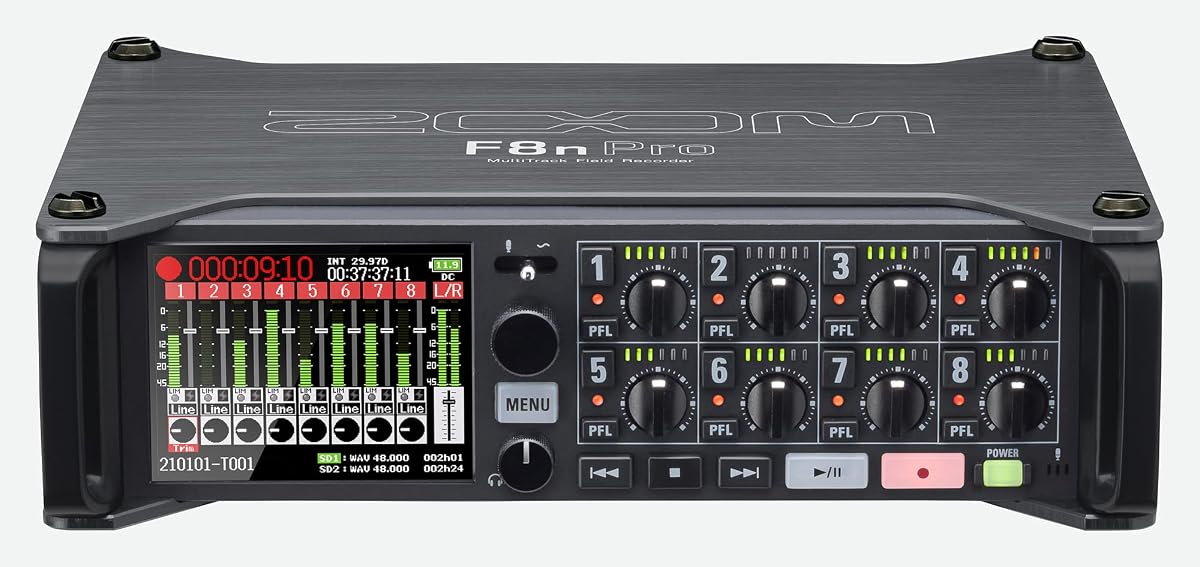
The Zoom F8n Pro is designed for production teams who need maximum channel count and redundancy without sacrificing audio fidelity. Its reputation for reliability makes it a staple on many professional film sets.
We may earn a commission when you buy through this link, at no additional cost to you.
Dual SD card slots allow for redundant recording, ensuring that critical takes are never lost due to card failure. The high gain preamps handle quiet dialogue with clarity while maintaining low noise floors.
Timecode accuracy is down to 0.2ppm, which means sync issues are virtually non-existent even over long shoots. You can also use it as a USB interface while recording to SD cards for maximum flexibility.
This unit is best for larger productions where every input matters and data security is paramount. If you need the highest level of control and reliability available today, the F8n Pro delivers.
Dual SD card slots enable redundant recording, so you have a backup of every take instantly without any extra effort.
Industry-leading timecode accuracy keeps your audio and video aligned perfectly throughout extended shooting days.
We may earn a commission when you buy through this link, at no additional cost to you.
The Zoom H1 XLR brings professional audio quality to filmmakers who need something small and affordable. It is perfect for solo creators or simple interview setups where two inputs are sufficient.
We may earn a commission when you buy through this link, at no additional cost to you.
With 32-bit float recording, you can ignore gain adjustments and focus on capturing the scene. The OLED display shows waveforms in real time so you always know your levels without guessing.
It supports high capacity SD cards for extended sessions and has 3.5mm jacks for additional flexibility. While it lacks advanced timecode features, it does the basics exceptionally well for the price.
This recorder is ideal for indie filmmakers or students starting out in audio capture. If you want reliable sound without breaking the bank, the H1 XLR is the smart entry point.
An OLED waveform display makes it easy to monitor audio levels at a glance, ensuring clean recordings every time.
Two XLR/TRS combo inputs let you connect microphones or instruments for versatile recording setups on the go.
We may earn a commission when you buy through this link, at no additional cost to you.
The Zoom F3 is built for real-world recording where there are no second chances. It offers a lightweight solution that does not sacrifice audio quality for convenience or portability in the field.
We may earn a commission when you buy through this link, at no additional cost to you.
Dual locking XLR inputs keep connections secure when the recorder is mounted out of reach or part of a larger rig. Ultra-low-noise preamps ensure clean audio even when conditions are not controlled.
Flexible power options and USB workflows keep you recording without interruption during long days on set. While it lacks some advanced features found in higher end models, it covers the essentials perfectly.
This unit is great for run-and-gun filmmakers who need reliability without bulk. If you want a dependable recorder that fits in any bag, the F3 is an excellent choice.
Dual locking XLR inputs keep cables secure during transport, preventing accidental disconnects on busy sets.
Ultra-low-noise preamps ensure clean and consistent audio quality even when recording in unpredictable environments.
We may earn a commission when you buy through this link, at no additional cost to you.
The Zoom H5 uses a system of interchangeable input capsules that can be swapped out as easily as the lens of a camera. This modularity makes it versatile for different recording scenarios and environments.
We may earn a commission when you buy through this link, at no additional cost to you.
It includes a detachable X/Y capsule with extended signal capacity and shock mounted mics for reduced handling noise. Two mic/line inputs with XLR/TRS combo connectors provide phantom power and pads for flexibility.
The safety net helps protect your recordings by capturing a secondary audio track for every second. While it supports smaller SD cards than modern units, it remains a favorite for its adaptability.
This recorder is ideal for those who need a tool that can grow with their skills. If you value flexibility and ease of use, the H5 delivers consistent performance across many tasks.
Interchangeable capsules allow you to change recording capabilities easily, adapting the unit to your specific needs.
A safety net feature protects your recordings by ensuring you never lose a critical take due to setting errors.
We may earn a commission when you buy through this link, at no additional cost to you.
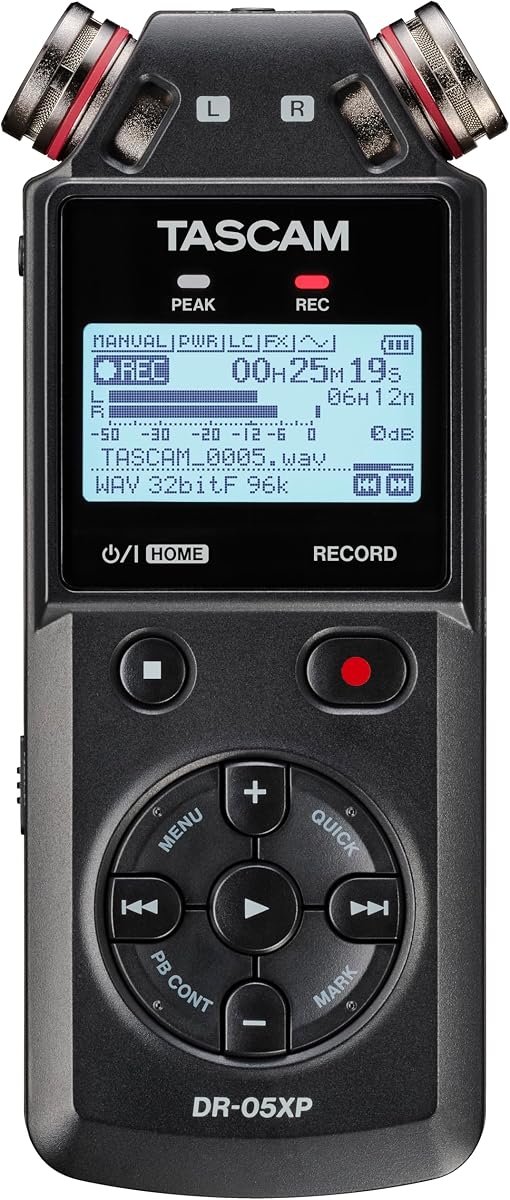
The TASCAM DR-05XP makes it easy to capture pro-quality recordings for music and audio for video with minimal effort. Its portable design fits easily into a pocket or bag for quick recording sessions.
We may earn a commission when you buy through this link, at no additional cost to you.
Flexible recording modes include 32-bit float and various sample rates to suit different project needs. Omnidirectional condenser microphones handle loud environments well, capturing ambient sound with clarity.
The 2-in/2-out USB-C audio interface lets you record directly to your computer or use it as a mic for streams. With up to 17.5 hours of operation, it handles long sessions without needing a power change.
This unit is great for casual filmmakers or students who need a simple tool. If you value convenience and battery life over advanced features, the DR-05XP is a practical pick.
With up to 17.5 hours of operation, you can record long takes and full sessions without worrying about battery drain.
USB-C connectivity allows you to record directly to a computer or use the device as a microphone for streaming.
We may earn a commission when you buy through this link, at no additional cost to you.
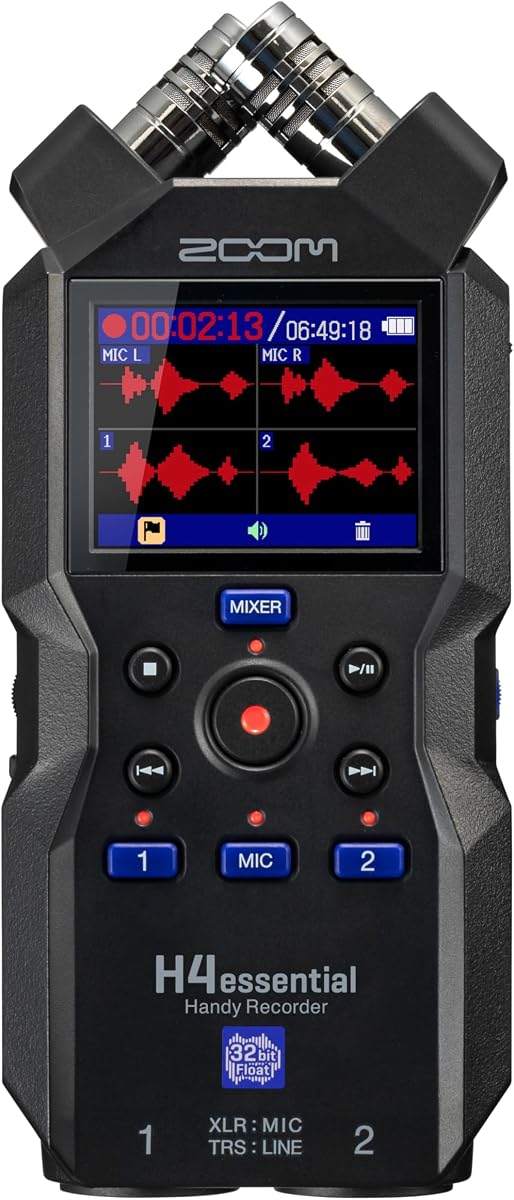
The Zoom H4 Essential helps you capture more of the moment without worrying about distorted takes on set. It is designed to be easier to use for more creators, including those new to field recording.
We may earn a commission when you buy through this link, at no additional cost to you.
Spoken menu guidance makes recording more accessible for visually impaired users and easier to navigate for anyone who wants a guided experience. You can connect external mics or plug into a mixer for flexible setups.
Recording to your device and SD card ensures you have a backup directly while also streaming to your computer via USB-C. It captures detailed audio for quiet dialogue or loud performances accurately.
This recorder is perfect for those who prioritize ease of use and flexibility. If you want a straightforward workflow that still delivers professional results, the H4 Essential is a smart choice.
Spoken menu guidance makes the device more accessible and easier to navigate for users of all abilities.
Backup directly to SD card while connecting to your computer ensures no data is lost during critical recording sessions.
We may earn a commission when you buy through this link, at no additional cost to you.
The TASCAM DR-10L Pro supports LTC Jam Sync for seamless timecode synchronization, ideal for multi-device setups. It delivers superior personal audio that is effortless to capture even in busy settings.
We may earn a commission when you buy through this link, at no additional cost to you.
Worry-free recording means 32-bit float captures everything from a whisper to a scream with pro-quality fidelity. The included TM-10L clip-on lavalier microphone is perfectly matched to the device for clear lifelike audio.
Support for high-capacity microSDXC media cards offers practically limitless storage for your projects. You can also master multi-unit control with up to 5 simultaneous recordings using the dedicated app.
This unit is best for documentary or reality production where subjects move around. If you need reliable personal audio with timecode support, the DR-10L Pro is an excellent investment.
LTC Jam Sync allows for seamless timecode synchronization across multiple devices for streamlined post-production workflows.
Support for high-capacity microSDXC cards provides practically limitless storage for long-form projects and extended shoots.
We may earn a commission when you buy through this link, at no additional cost to you.
The Zoom H1 Essential helps you capture clear stereo audio for videos that needs more polished sound than your camera alone. It is ready when inspiration hits to record songwriting sessions or rehearsals easily.
We may earn a commission when you buy through this link, at no additional cost to you.
Record conversations and podcasts with natural stereo sound that helps voices come through clearly. You can capture real-world sound like ambience and room tone for video production effectively.
Connect via USB-C to use it as a microphone for livestreams or remote meetings. It balances simplicity with performance well, making it a great tool for everyday creators.
This recorder is ideal for beginners who want better audio without complexity. If you want a simple tool that just works, the H1 Essential is the way to go.
Natural stereo sound helps voices come through clearly, making it great for interviews and podcast episodes.
Use it as a microphone for livestreams and calls, adding versatility to your content creation workflow.
We may earn a commission when you buy through this link, at no additional cost to you.
The Zoom F2 is the smallest 32-bit float recorder you can wear, capturing clip-free audio at any volume level. It comes with a lavalier microphone ready to go for interviews and vlogs.
We may earn a commission when you buy through this link, at no additional cost to you.
Runs up to 15 hours on just 2 AAA batteries, making it one of the most power-efficient field recorders available. Supports microSD cards up to 512GB for ample storage on long shoots.
The REC Hold switch prevents accidental stops during critical recordings, while the internal clock ensures perfect audio and video sync. You can focus entirely on your content without worrying about settings.
This unit is perfect for journalists and videographers who need a discreet solution. If you want a small wearable recorder that just works, the F2 is a strong option.
The smallest 32-bit float recorder you can wear, capturing audio discreetly without drawing attention to the setup.
Runs up to 15 hours on just 2 AAA batteries, making it one of the most power-efficient recorders on the market.
We may earn a commission when you buy through this link, at no additional cost to you.
Selecting the right recorder involves balancing input count, timecode support, and portability to match your workflow needs.
Consider how many microphones you typically need to connect simultaneously. Most field recorders offer between two and eight inputs. If you work with multiple boom mics or lavs, higher input counts give you more creative freedom.
For solo or small productions, two inputs are often sufficient to keep the setup simple and portable.
Timecode is essential for syncing audio to video frames during editing. Look for units that support external timecode inputs or sync with cameras directly. Accurate timecode prevents hours of manual syncing in post-production.
If your workflow involves multiple cameras or long takes, prioritizing robust timecode features will save significant time.
32-bit float recording is becoming the standard for field work because it prevents clipping even if levels are set wrong. This technology allows you to capture everything from whispers to shouts without losing detail.
Choosing a recorder with 32-bit float ensures your audio is usable regardless of your gain settings during the shoot.
Field recording often happens without access to outlets for long periods. Check the battery type and expected run time to ensure it matches your shooting day. Some units support external power or USB power banks.
Prioritize models with replaceable batteries or flexible power sources to avoid interruptions during critical scenes.
Field recorders face bumps, weather, and constant handling. A rugged construction ensures the device survives demanding conditions without failure. Look for metal housings and reinforced connectors.
Investing in a durable unit protects your investment and ensures reliability when you need it most.
High quality audio files take up significant space. Choose a recorder that supports large capacity SD or microSD cards to avoid running out of space mid-shoot. Some units offer dual slots for redundancy.
Ensure your storage options match your recording format to avoid data limitations during production.
Carrying heavy gear can slow down your crew. A compact unit reduces fatigue and allows for quicker setups. However, small devices may lack advanced controls or inputs.
Balance the size of the unit with the features you need to ensure comfort without sacrificing capability.
Field recorders range from affordable entry-level units to premium professional tools. Determine your budget based on the frequency of use and production standards. Higher prices often reflect better preamps and features.
Prioritize value by focusing on features that directly impact your workflow rather than unnecessary extras.
Always perform a test recording before the shoot to check battery levels and card space. Ensure you understand the gain settings and timecode configuration for your specific camera.
Keep the device clean and dry using a soft cloth for regular maintenance. Store the unit in a padded case to protect it from impacts when traveling between locations.
Regularly update the firmware provided by the manufacturer to access new features and bug fixes. Backup your recordings immediately after each shoot to prevent data loss during editing.
For beginners, the Zoom H1 XLR is a great choice due to its simplicity and professional features. It offers 32-bit float recording and two XLR inputs without overwhelming complexity. This balance allows new users to capture clean audio while learning the basics of field recording.
Timecode is essential if you work with multiple cameras or complex setups. It ensures your audio and video stay perfectly synced during editing. For simple single camera shoots, a recorder without timecode can work if you use a clap or slate to sync manually.
If you record interviews or small scenes, two inputs are usually sufficient. For more complex setups with multiple mics, consider a unit with at least four inputs. This flexibility allows you to adapt to different production needs easily.
32-bit float recording captures a wider dynamic range than standard formats, preventing digital clipping. It allows you to set high gain without distortion and pull down loud sounds in post. This ensures your audio is clean even if levels change unexpectedly.
Battery life varies by model, typically ranging from ten to twenty hours on rechargeable or standard batteries. Always carry spare batteries for long shoots to avoid running out of power. External power options like USB banks can extend runtime significantly.
Expensive recorders often offer better preamps, timecode accuracy, and build quality. If you produce frequently or require professional reliability, investing in a high-end unit pays off. For occasional use, mid-range models may provide the best value for your needs.
We have reviewed ten top field recorders ranging from budget friendly to premium professional options. Each unit offers unique strengths whether you need inputs, timecode, or portability for your production.
Prioritize features that directly impact your workflow like input count and timecode sync. Understanding your specific needs will help you narrow down the options effectively.
Always check current pricing and availability before buying since stock and deals change often. We hope this guide helps you select the right tool for your filmmaking journey.