
Vogzone MCX4121A-ACAT
4.7Editor score
Mellanox ConnectX-4 Lx
RDMA support included
Wide OS compatibility
This guide compares the top 25GbE network cards for servers and NAS, evaluating performance, compatibility, and features to help you choose the right adapter.
High-speed networking is essential for modern data centers and enterprise environments. A reliable 25GbE network card ensures fast data transfer and low latency for demanding workloads like virtualization and storage.
We compared ten top-rated adapters based on controller quality, port options, and OS support. Our analysis focuses on real-world performance, compatibility with existing infrastructure, and value for different user needs.
Each pick highlights key strengths and ideal use cases for professionals. Prices and availability change frequently, so verify current details on the product pages before making your final purchasing decision.
4.7Editor score

4.8Editor score

5.0Editor score
The following table provides a side-by-side comparison of all ten network adapters. Review the specifications and features to find the model that best fits your server or workstation requirements.


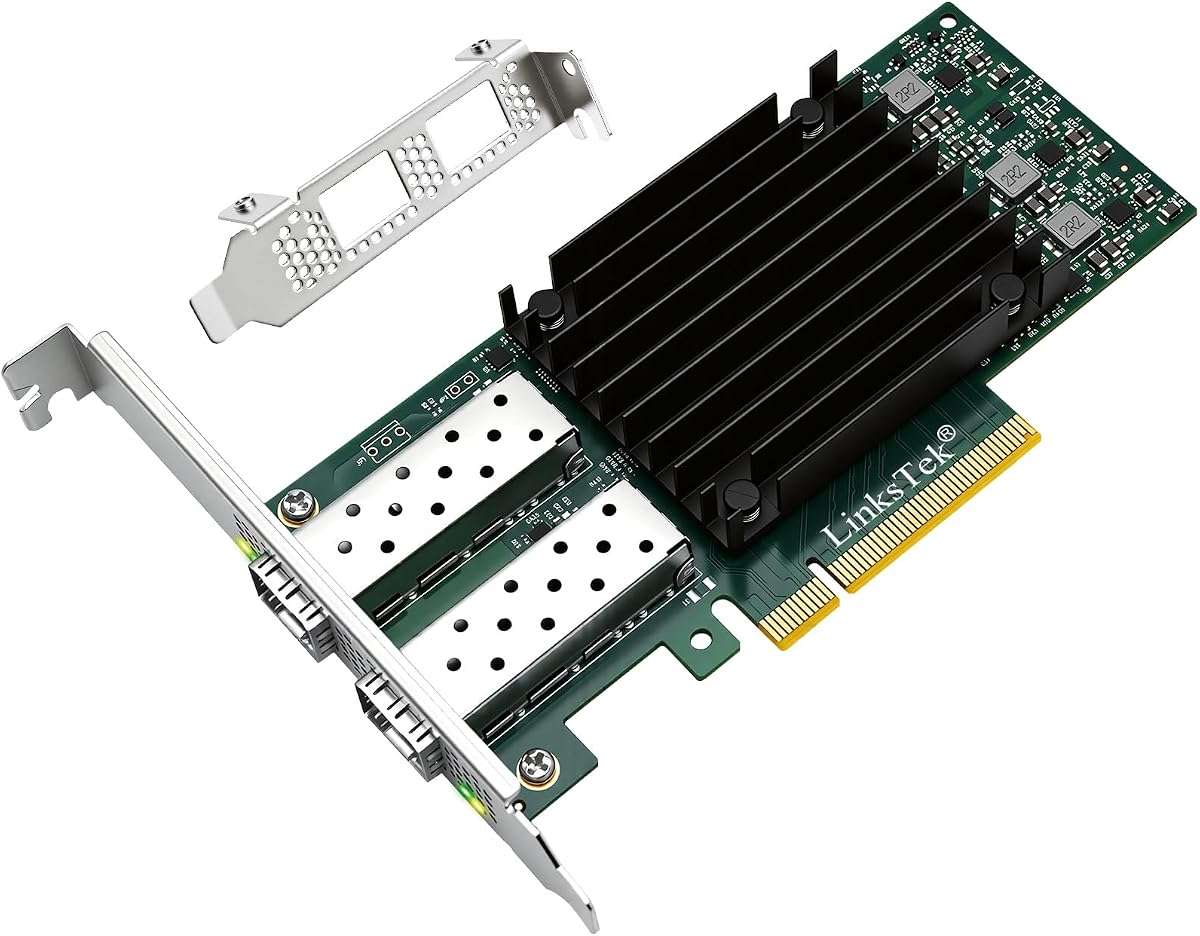


This network card delivers enterprise-grade performance with its Intel E810 controller. It supports dual 25GbE ports that ensure reliable data transfer across critical network infrastructure.
We may earn a commission when you buy through this link, at no additional cost to you.
The card features Port Trunking to combine both ports for up to 50 Gbps transfer speeds. Forward Error Correction ensures data integrity for enterprise-level networks running intensive applications.
It supports QNAP QTS, QuTS hero, Windows, and Linux operating systems. The included low-profile bracket makes it suitable for compact server chassis configurations.
Buy this if you need a robust dual-port solution for NAS or enterprise servers. It is an excellent choice for accelerating file sharing and high-speed data transfers.
Forward Error Correction technology ensures reliable data transfer without retransmissions. This is critical for maintaining performance in enterprise-level networks with high traffic loads.
The adapter supports QNAP QTS, QuTS hero, Windows, and Linux. This broad compatibility ensures it fits into diverse IT environments and storage solutions.
We may earn a commission when you buy through this link, at no additional cost to you.
This adapter is designed specifically for Synology systems to enhance storage performance. It enables higher simultaneous throughput for demanding NAS workloads.
We may earn a commission when you buy through this link, at no additional cost to you.
The two 25GbE ports support port failover and load balancing. This ensures your network remains resilient and efficient even during hardware issues.
Synology provides a five-year warranty for this network adapter. It requires DSM 7.1.1-42962 Update 5 or above for full functionality.
Choose this if you own a compatible Synology NAS. It is the optimal choice for maximizing storage speed and reliability within the Synology ecosystem.
This adapter is purpose-built for Synology DSM systems. It integrates seamlessly with the operating system for easy configuration and management.
A five-year warranty provides long-term peace of mind. This reflects the manufacturer confidence in the durability and quality of the adapter.
We may earn a commission when you buy through this link, at no additional cost to you.
This card offers exceptional value with its original Mellanox ConnectX-4 Lx controller. It provides unmatched scalability and efficiency for cloud and storage platforms.
We may earn a commission when you buy through this link, at no additional cost to you.
The dual SFP28 ports support 1GbE, 10GbE, and 25GbE speeds. You can connect to various network cables to meet the demands of data center environments.
It supports RDMA, RoCE v1, v2, and many virtualization features like SR-IOV. The adapter works with Windows, Linux, VMware, and other major operating systems.
This is the best budget option for high-performance networking. It delivers reliable hardware-based isolation without the high cost of proprietary solutions.
This solution is the most cost-effective and flexible for web 2.0 and cloud applications. It achieves high performance without unnecessary expense.
Supported operating systems include Windows, Linux, Ubuntu, VMware, and FreeBSD. This broad support ensures it fits into almost any virtualized environment.
We may earn a commission when you buy through this link, at no additional cost to you.
This adapter features a PCIe 4.0 x8 interface for high-speed data transfer. It is equipped with the Intel E810-XXVDA2 controller for reliable performance.
We may earn a commission when you buy through this link, at no additional cost to you.
The card supports iWARP and RoCEv2 RDMA technologies. These features enable efficient packet processing and reduced latency for virtualization workloads.
It is compatible with Windows 10/11, Linux distributions, and VMware ESXi. Giant frames up to 9.5KB are supported for optimized network throughput.
Buy this if you need a modern PCIe 4.0 card for server applications. It offers excellent performance for Linux and Windows-based virtualization environments.
The PCIe 4.0 x8 interface provides 16 GT/s speeds. This ensures the network card can handle high bandwidth demands without bottlenecks.
Support for RDMA and SR-IOV enables efficient virtual machine resource management. This is ideal for environments with multiple VMs sharing network resources.
We may earn a commission when you buy through this link, at no additional cost to you.
This adapter is based on the Mellanox ConnectX-4 Lx EN controller. It provides a cost-effective and flexible Ethernet solution for data platforms.
We may earn a commission when you buy through this link, at no additional cost to you.
It supports RDMA over RoCE for low latency networking. The SR-IOV technology enables efficient management of I/O resources for virtual machines.
The card supports IEEE standards and jumbo frames up to 9.6KB. It is compatible with Windows, Linux, and VMware systems out of the box.
This is a great choice for virtualization and storage servers. It handles high bandwidth workloads efficiently while supporting advanced overlay networks.
Support for RDMA over RoCE enables low latency networking. This is essential for big data and cloud applications requiring fast response times.
The adapter supports VXLAN, NVGRE, and GENEVE overlay networks. This flexibility is ideal for complex virtualized network architectures.
We may earn a commission when you buy through this link, at no additional cost to you.
This adapter complies with IEEE 802.3by and 25GEthernet.org specifications. It offers network virtualization offloads including VXLAN and NVGRE.
We may earn a commission when you buy through this link, at no additional cost to you.
Intel Flow Director provides hardware-based application traffic steering. Dynamic Device Personalization increases packet processing efficiency for NFV deployments.
The card is optimized for high performance on servers with Intel Xeon processors. It delivers excellent small packet performance for network appliances.
Choose this for enterprise cloud deployments and network functions virtualization. It maximizes performance with the specific hardware optimizations Intel provides.
Hardware offloads for VXLAN and GENEVE improve traffic steering. This reduces CPU load and boosts overall network efficiency in virtualized systems.
The adapter is optimized for Data Plane Development Kit (DPDK). This allows for efficient packet processing in high-performance network applications.
We may earn a commission when you buy through this link, at no additional cost to you.
This card uses the Intel E810-XXVAM2 controller for stable 25GbE throughput. It features flexible port partitioning and traffic management capabilities.
We may earn a commission when you buy through this link, at no additional cost to you.
The adapter supports IEEE 1588 PTP and iWARP RDMA. It works with any MSA-compliant SFP28 module without vendor lock-in restrictions.
It supports Windows Server, RHEL, Ubuntu, and FreeBSD operating systems. VMDq and PXE boot are available for low-latency server environments.
This is ideal for server and storage networks using OCP 3.0 standards. It offers enterprise-grade features in a compact and efficient mezzanine adapter.
Unlocked slots work with any MSA-compliant SFP28 module. This allows you to choose cables and optics that fit your budget and needs.
Flexible Port Partitioning and on-chip QoS ensure traffic control. This helps prioritize critical data workloads in shared network environments.
We may earn a commission when you buy through this link, at no additional cost to you.
This adapter adds dual high-speed 25GbE network connections to Thunderbolt computers. It is ideal for shared storage and media production workflows.
We may earn a commission when you buy through this link, at no additional cost to you.
The package includes two 25GBASE-SR SFP28 optical transceivers. You can deploy this immediately on compatible fiber network infrastructure without extra purchases.
It delivers full 25GbE performance over Thunderbolt 5. The compact design is noiseless, making it perfect for studios and offices.
Choose this if you need high-speed networking on a Mac or PC without internal slots. It bridges the gap between Thunderbolt systems and enterprise networks.
Two 25GBASE-SR SFP28 optical transceivers are included. This saves cost and time by providing the necessary hardware to get started.
Thunderbolt 5 delivers the bandwidth for both 25GbE ports. This ensures no bottlenecks when connecting to high-speed networks.
We may earn a commission when you buy through this link, at no additional cost to you.
This card is a simple way to add dual optical 25GbE connections to any computer. It includes high-performance 25GBASE SFP28 transceivers.
We may earn a commission when you buy through this link, at no additional cost to you.
The adapter is backward compatible with 10GbE infrastructure. This allows you to integrate with existing systems now and upgrade later.
It is compatible with Mac, Windows, and Linux systems. You can use it in computers with PCIe card slots or Thunderbolt expansion systems.
Buy this for a reliable internal networking upgrade. It offers great value by including transceivers and supporting multiple operating systems.
The adapter includes two 25GBASE SFP28 transceivers. This simplifies setup and ensures you have everything needed for immediate deployment.
Backward compatibility with 10GbE makes upgrades seamless. You can start with existing switches and move to 25GbE when ready.
We may earn a commission when you buy through this link, at no additional cost to you.
This intelligent RDMA-enabled adapter provides advanced application offload capabilities. It is designed for web 2.0, cloud, and storage platforms.
We may earn a commission when you buy through this link, at no additional cost to you.
The ConnectX-5 Ethernet adapter offers reliable dual-port performance. It supports PCIe 3.0 x8 interfaces and SFP28 connections.
It includes a tall bracket for full-size server installations. The RDMA features enable efficient data transfer for demanding network workloads.
Choose this if you need a trusted legacy solution for RDMA environments. It continues to deliver stable performance for specific server applications.
Advanced application offload capabilities reduce CPU overhead. This improves efficiency for cloud and storage platform operations.
The adapter comes with a tall bracket for standard chassis. This ensures secure installation in larger server environments.
We may earn a commission when you buy through this link, at no additional cost to you.
Selecting the right 25GbE network card depends on your specific hardware and workload requirements. Here are key factors to consider before purchasing.
The network controller is the brain of the adapter. Look for reputable manufacturers like Intel or Mellanox for reliable performance.
A high-quality controller ensures stable throughput and advanced features.
Most cards offer dual ports for redundancy or increased bandwidth. Verify the port type is SFP28 for 25GbE support.
Dual ports provide flexibility for link aggregation and failover.
Check if your motherboard supports PCIe 3.0 or 4.0. Newer versions offer higher bandwidth for data transfers.
Match the PCIe version to your slot capabilities for best speed.
Ensure drivers are available for your OS like Windows, Linux, or VMware. Compatibility lists are critical for enterprise deployments.
Confirm OS support to avoid driver issues and installation problems.
RDMA enables low-latency communication without CPU overhead. This is essential for virtualization and high-performance storage.
Look for RoCE or iWARP support depending on your network needs.
Consider whether you need a full-height or low-profile bracket. Some servers require specific physical dimensions for installation.
Choose the form factor that fits your server chassis design.
Some cards include SFP28 transceivers while others require separate purchases. This affects the total cost of deployment.
Verify if optics are included to plan your budget accurately.
Long warranties indicate manufacturer confidence and protect your investment. Check for support availability in your region.
A solid warranty ensures long-term peace of mind.
Install the card in an available PCIe slot and secure it with brackets. Ensure the slot is properly seated for reliable contact.
Install drivers from the manufacturer website for your OS. Configure port settings and speed in your system preferences.
Clean ports regularly to avoid dust buildup that affects connection. Use fiber or DAC cables as required by your switch.
PCIe 4.0 offers higher bandwidth than 3.0 allowing more data throughput. It is more future-proof for high-speed server applications and data centers.
Some cards include transceivers while others do not. Check the product details carefully before purchasing to confirm if optics are included.
Yes most adapters support auto-negotiation down to 10GbE. This ensures backward compatibility with older network switches and equipment.
RDMA helps reduce latency for virtualization but may not be needed for basic storage. Evaluate your workload to decide if it is worth the cost.
Most cards support Windows, Linux, VMware, and FreeBSD. Always verify compatibility lists on the product page for your specific OS version.
Power down your PC insert the card into a PCIe slot and secure it. Install drivers and configure network settings through your OS.
Many support port trunking and link aggregation for higher speeds. This combines ports to achieve speeds up to 50 Gbps total bandwidth.
We reviewed ten top options including the QXG-25G2SF-E810 and Sonnet adapters. Each offers unique benefits for servers NAS and professional workstations.
Prioritize controller quality and OS compatibility for reliable performance. RDMA and PCIe versions should match your specific workload needs.
Prices and availability change frequently. Check the product pages for the latest details before finalizing your purchase decision.