
Clarity AltoPlus Amplified Phone
Up to 53dB amplification
Talking keypad and Caller ID
TIA certified for hearing loss
This guide compares the top captioned telephones for hearing impaired users, featuring real-time captions, amplified sound, and large displays for clearer
Navigating communication challenges can be difficult for individuals with hearing loss. Captioned telephones bridge the gap by displaying real-time text alongside audio calls. These devices ensure that every word is heard and understood, providing independence and confidence during conversations with family and friends.
We have carefully evaluated the market to identify the most effective solutions for hard-of-hearing individuals. Our analysis considers features like amplification levels, display size, ease of use, and captioning service reliability. This list covers a range of options from budget-friendly amplified models to premium captioned systems with advanced accessibility features.
Each selection in this guide highlights unique strengths tailored to specific needs and preferences. You will find detailed breakdowns of functionality, design, and user experience to help you make an informed decision. Please note that product availability and pricing can change frequently, so verify current details before purchasing.

4.3Editor score

The following table provides a side-by-side overview of all ten selected products. It highlights key specifications such as amplification levels, display types, and special features to help you quickly compare options based on your specific requirements.




The Hamilton CapTel 2400iSPNBT stands out as a top-tier solution for individuals seeking clarity in phone conversations. With a 4.3-star rating, users appreciate its ability to combine audio with real-time text captions. This dual approach ensures that no word is missed during critical calls with loved ones or healthcare providers.
We may earn a commission when you buy through this link, at no additional cost to you.
Its large touchscreen makes navigation intuitive, allowing users to adjust caption sizes and tone controls easily. The device supports both auto captions and assisted captions with live operator support, offering flexibility based on user preference. Additionally, the built-in answering machine displays voicemail captions directly on the screen for convenient review.
While the device requires a high-speed internet connection and service registration for US residents, these requirements are standard for captioned telephones. The need for electrical power and telephone service is also typical. Despite these minor hurdles, the clarity provided by the captions makes the setup process worthwhile for most users.
This phone is ideal for seniors and individuals with moderate hearing loss who need visual confirmation of spoken words. It bridges the gap between hearing and listening, fostering confidence during daily communication. If you need a reliable captioned system with modern touch features, this model is a strong recommendation.
Real-time captions ensure every word is visible, reducing misunderstandings and stress during calls.
Hearing aid compatibility and adjustable volume control allow users to customize the experience to their needs.
We may earn a commission when you buy through this link, at no additional cost to you.
The Geemarc Ampli550 is designed specifically for hard-of-hearing individuals who need loud, clear sound. It focuses on amplification rather than captioning, making it suitable for those who can hear better with boosted volume. Users praise its extra-loud ringer and flashing strobe light that ensure calls are never missed.
We may earn a commission when you buy through this link, at no additional cost to you.
Key features include talking keys and a talking Caller ID, which audibly announce button presses and caller names. This is particularly helpful for users with low vision or cognitive challenges. The ergonomic design includes emergency keys and memory dial buttons for frequent contacts, simplifying the dialing process significantly.
While it does not offer captioning, its audio clarity is exceptional with up to 55dB of TrueSound amplification. The compatibility with various headset and neck loop accessories adds flexibility for different hearing aid setups. Some users might prefer a cordless option, but the corded reliability is a benefit for stable connections.
This phone is a robust choice for those who prioritize sound volume and visual alerts over text captions. It works well in homes where missing calls is a major concern due to hearing limitations. If you need a device that shouts when the phone rings, this model delivers effectively.
Flashing strobe lights and a 95dB ringer ensure no call goes unnoticed even in noisy environments.
Talking keys and large buttons make dialing simple and reduce errors for users with dexterity issues.
We may earn a commission when you buy through this link, at no additional cost to you.
The Captel MDL 200 offers an accessible entry point for users seeking captioned telephone services. While detailed specifications are minimal in public data, its positioning suggests a focus on essential functionality. It allows users to read captions while listening, which is vital for clarity during conversations with family or medical professionals.
We may earn a commission when you buy through this link, at no additional cost to you.
As a corded device, it provides a stable connection without the worry of battery replacement or wireless interference. The simplicity of the design means fewer buttons and settings to manage, which can be reassuring for elderly users or those new to assistive technology. It aligns with the core purpose of bridging communication gaps.
Potential users should note that it may lack advanced features like touchscreens or large displays found in premium models. However, for those on a budget, it serves as a practical tool for basic communication needs. The captioning service is a key component that ensures text is available for every call.
This phone is best suited for individuals who need a straightforward, cost-effective solution for captioned calling. It avoids unnecessary complexity while delivering the primary benefit of text-based conversation support. If you prioritize affordability and reliability, this model is worth considering for home use.
Focuses on core captioning features to provide clear communication without extra bells and whistles.
Provides an affordable way to access captioning services without high monthly equipment costs.
We may earn a commission when you buy through this link, at no additional cost to you.
The Clarity AltoPlus is engineered for users with significant hearing loss who require powerful audio enhancement. With up to 53dB amplification and TIA certification, it meets rigorous standards for mild, moderate, and severe hearing impairments. Its design prioritizes clarity and ease of use for those who struggle with standard phone volumes.
We may earn a commission when you buy through this link, at no additional cost to you.
Features like outgoing speech amplification ensure that the user's voice is also heard clearly by the caller. The talking keypad and Caller ID support auditory confirmation of actions, which reduces dialing errors. Visual indicators on the backlit screen further assist users who rely on sight cues during calls.
While it does not offer captioning, its acoustic performance is robust. The ergonomic controls are designed to accommodate arthritis or limited dexterity, making it physically easier to operate. The option to connect neck loops and headsets adds another layer of accessibility for hearing aid users.
This phone is an excellent choice for those who need maximum volume and safety certifications. It addresses both incoming and outgoing communication challenges effectively. If you need a reliable amplified phone that supports severe hearing loss without relying on captions, this is a top contender.
TIA certification ensures the device meets high standards for amplification and hearing safety.
Outgoing speech amplification helps ensure your voice is loud enough for the other party.
We may earn a commission when you buy through this link, at no additional cost to you.
The Serene Innovations SI-CL-65 combines cordless convenience with amplified audio features designed for seniors. It emphasizes HD talking Caller ID to help users know who is calling without lifting the receiver. This feature is particularly useful for identifying important calls before committing to a conversation.
We may earn a commission when you buy through this link, at no additional cost to you.
The cordless handset offers mobility within the home, allowing users to answer calls from anywhere. Amplified sound ensures that conversations remain clear even if the user has mild to moderate hearing loss. The interface is designed for ease of use, avoiding complex menus that might confuse elderly users.
While specific amplification levels are not detailed, the focus on HD quality suggests a commitment to sound clarity. Users will need to manage battery life for the cordless handset, which is a standard trade-off for mobility. The device provides a practical solution for those who value flexibility.
This phone is suitable for individuals who want to stay connected without being tethered to a base unit. It balances mobility with essential hearing assistive features. If you need a cordless phone that supports clearer communication and basic accessibility, this model is worth exploring.
Cordless design allows you to move around freely while keeping the communication line open.
Talking Caller ID ensures you know who is calling, reducing uncertainty and missed calls.
We may earn a commission when you buy through this link, at no additional cost to you.
The VTech SN5147 offers a hybrid system that provides the reliability of a corded base with the mobility of a cordless handset. Its 4-star rating reflects strong user satisfaction with its amplified sound and large buttons. This model is designed to handle both daily calls and emergency contacts efficiently.
We may earn a commission when you buy through this link, at no additional cost to you.
Key features include photo speed dial slots that allow users to dial contacts with one touch using images. The 90dB ringer with visual alerts ensures calls are not missed even when the phone is out of hearing range. The built-in call blocker helps reduce unwanted robocalls that often trouble seniors.
The answering machine allows for remote access and slow playback of messages, which can be helpful for users with slower processing speeds. While it lacks captioning, the audio amplification and visual cues compensate for hearing loss. The expandable system allows up to four handsets for large households.
This phone is ideal for seniors who want a mix of mobility and security features. It addresses common annoyances like spam calls and missed rings. If you need a versatile system that supports both corded reliability and cordless convenience, this model is a solid choice.
Call blocking features protect users from annoying robocalls and unwanted numbers effectively.
Photo speed dial simplifies calling family members by using pictures instead of numbers.
We may earn a commission when you buy through this link, at no additional cost to you.
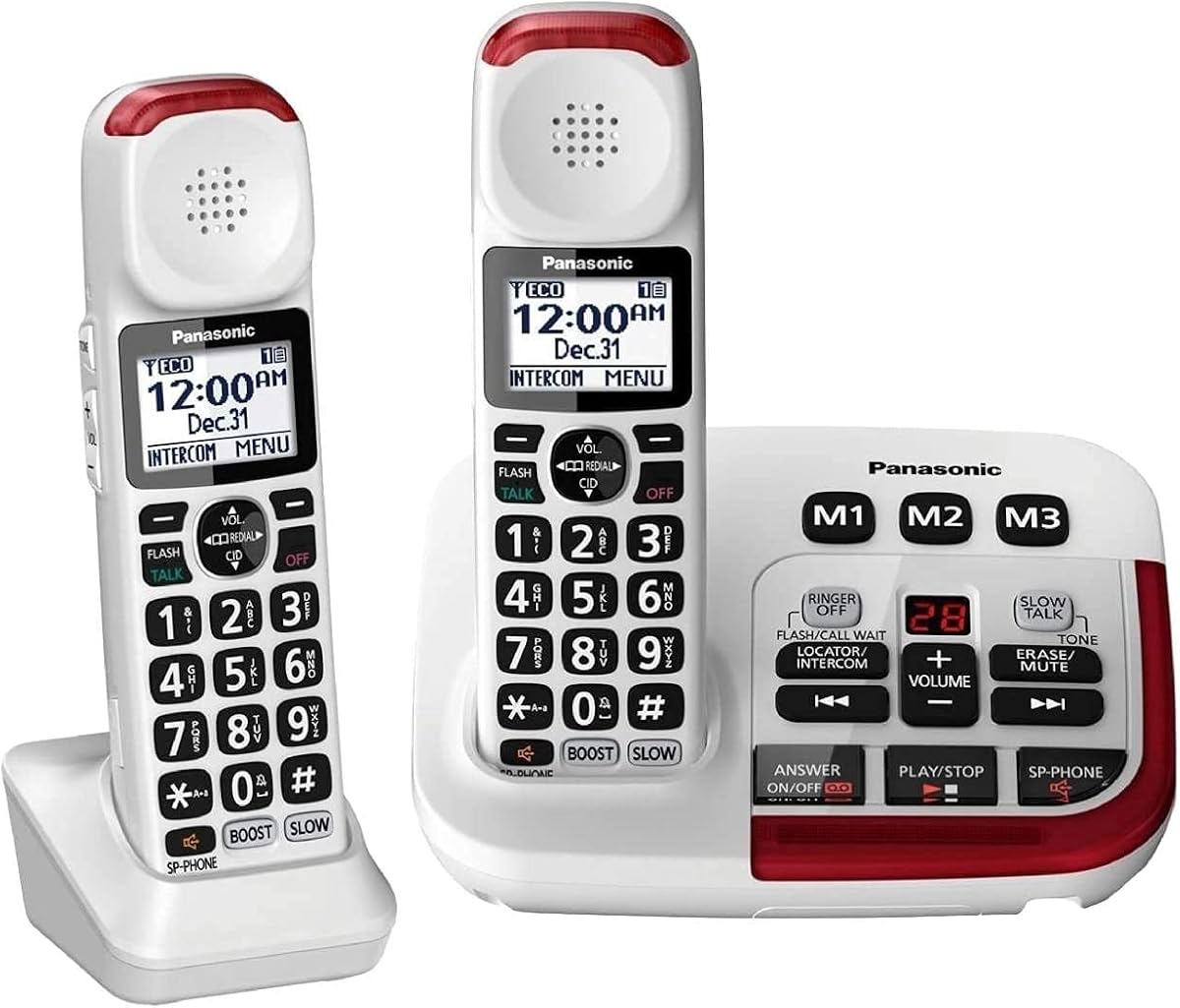
The Panasonic KX-TGM420W is a versatile cordless system that includes features specifically designed to assist hearing-impaired users. With up to 40dB of volume boost, it significantly amplifies incoming calls for better clarity. The noise reduction technology helps suppress background noise for a more comfortable listening experience.
We may earn a commission when you buy through this link, at no additional cost to you.
One standout feature is the Slow Talk function which slows down speech in real time and for voice messages. This gives users more time to process what is being said, which is incredibly helpful for cognitive or auditory processing challenges. The talking Caller ID ensures users know who is on the line.
The system includes two handsets and is expandable to six, making it suitable for multi-room homes. A digital answering machine and power backup ensure communication remains uninterrupted during outages. While it does not provide captions, its audio enhancements are substantial for many users.
This phone is best for those who need robust audio control and flexibility across a home. The slow talk feature makes it unique among standard cordless phones. If you prioritize hearing enhancement and message clarity, this Panasonic model offers strong performance.
Slow talk feature helps users process information at a comfortable pace during calls and messages.
Built-in noise reduction filters out background sounds to focus on the caller's voice.
We may earn a commission when you buy through this link, at no additional cost to you.
The SWISSVOICE Premium 3355 focuses on simplifying communication for the elderly with large buttons and photos. It includes both a corded and cordless handset to offer flexible usage options. The design supports those with unsteady hands or low vision by making visual identification of contacts simple and clear.
We may earn a commission when you buy through this link, at no additional cost to you.
With a 90dB ringer volume, this phone ensures that incoming calls are heard in almost any environment. The photo memory buttons allow quick dialing with a single press. Additionally, the call block feature helps protect users from unwanted calls. It is also hearing aid compatible for better audio quality.
User reviews suggest that while the features are useful, the setup process might be challenging for some. However, once configured, the device provides reliable service with clear audio and visual alerts. The extra cordless handset adds value for families needing multiple points of contact.
This phone is suitable for households seeking a combination of loud sound and visual cues. It helps seniors stay connected with family through simplified interfaces. If you need a phone that emphasizes ease of use and volume, this model is a practical choice.
Photo buttons make dialing easy by associating numbers with familiar faces or names.
SOS buttons and large keys ensure emergency contacts can be reached quickly and safely.
We may earn a commission when you buy through this link, at no additional cost to you.
This variant of the Panasonic KX-TGM420W offers two handsets in one package, providing better value for families. It retains all the accessibility features of the single handset version including the 40dB volume boost and slow talk functionality. It is designed to help hearing-impaired users hear every word clearly without straining.
We may earn a commission when you buy through this link, at no additional cost to you.
The expandability to six handsets means the system can grow with your household needs. Users can place units in different rooms without losing call quality or functionality. The noise reduction technology ensures that conversations remain clear even in a busy home environment.
The inclusion of two handsets means one can stay on the base while another is moved around. This is particularly useful for caregivers who need to stay connected to an elderly family member. The answering machine supports slow playback of messages for easier understanding.
This bundle is best for multi-room setups where accessibility is a priority throughout the house. It combines practicality with essential hearing support features. If you need multiple units to keep everyone connected, this kit is a comprehensive solution.
Two handsets allow multiple family members to access the phone features easily.
Volume boost and slow talk help ensure that all spoken words are heard and understood.
We may earn a commission when you buy through this link, at no additional cost to you.
This amplified landline phone is built for seniors who need exceptionally loud ringer volume and simple controls. With a 100dB ringer, it is one of the loudest options available, ensuring calls are never missed. The photo speed dial feature lets users call contacts with a single touch using a picture.
We may earn a commission when you buy through this link, at no additional cost to you.
It offers up to 80dB of receiver gain for loud incoming calls and is hearing aid compatible. The LED flash alert provides a visual cue when a call comes in, which is helpful in quiet or noisy settings. The wired design means no need to worry about batteries or charging.
While programming memory keys can sometimes require repeating steps, the overall usability is high. The call indicator light and easy redial function add to its user-friendly nature. It serves well as a reliable desk phone for daily use in a home or office setting.
This phone is ideal for those who prioritize volume and simplicity over advanced features. It is a practical tool for staying connected without technical hurdles. If you need a loud, straightforward phone for seniors, this model offers strong value.
The 100dB ringer ensures you are alerted immediately even if you have severe hearing loss.
Wired design and big buttons eliminate distractions and focus on making and receiving calls easily.
We may earn a commission when you buy through this link, at no additional cost to you.
Choosing the right telephone requires understanding your specific hearing needs and lifestyle preferences. This guide breaks down the key factors to consider before making your decision.
Captioned telephones display real-time text of conversations, which is vital for those with severe hearing loss who miss words. Amplified phones boost sound volume but do not provide text. Decide if you need visual text support or just louder audio.
If you often miss words during calls, opt for a captioned model. If you prefer audio clarity and have mild loss, an amplified phone may suffice.
Look for amplification levels ranging from 40dB to 100dB depending on your hearing loss severity. High amplification ensures that voices are heard clearly without distortion. Some models include tone controls to adjust sound quality.
Choose a phone that offers enough volume to meet your daily needs without causing discomfort or feedback.
Large backlit displays and big buttons are essential for users with low vision or arthritis. Touchscreens offer modern navigation but physical buttons provide reliability. Ensure the interface is intuitive and easy to manage.
Prioritize clear displays and large controls to make dialing and reading easier for your eyes and fingers.
Captioned telephones typically require high-speed internet to function properly. Amplified landlines need standard telephone service. Cordless models require battery management while corded models need power outlets. Verify your home setup before buying.
Check if you have the necessary internet or phone service to run the device as intended.
Many modern phones are compatible with hearing aids to reduce feedback and noise interference. Look for models with TIA certification or specific mentions of compatibility. This ensures a smoother experience if you wear hearing aids daily.
Select a model that explicitly states compatibility with your hearing aids for best performance.
Features like talking Caller ID, speed dial, and call blocking add convenience and safety. Some phones include answering machines with slow playback capabilities. These extras can simplify communication and reduce stress.
Evaluate which extra features align with your daily routine and accessibility needs.
Prices vary widely from basic models to premium systems. Consider your budget but prioritize essential features that improve quality of life. Remember that some services might have subscription costs associated with captioning.
Balance cost with functionality to find a device that fits your financial and accessibility requirements.
Consider how easy the phone is to set up and whether customer support is available. Some models require registration for captioning services. Clear manuals and responsive support can save time and frustration.
Look for devices with clear instructions and good support networks to ensure a smooth experience.
To start using your captioned phone, connect it to a high-speed internet source and register for the captioning service as required. Once set up, test the device by making a simple call to ensure both audio and text are functioning correctly.
Regularly clean the keypad and display with a dry soft cloth to avoid dust buildup. If your model uses batteries for backup, check their status periodically to ensure they are ready for power outages.
Adjust volume and caption settings to your comfort level using the on-screen menu or physical buttons. If you encounter issues, refer to the user manual for troubleshooting steps or contact customer support for further assistance.
Most captioned telephones use free captioning services funded by federal programs for eligible US residents. However, some models may require a specific internet connection or monthly service fee. Always check the manufacturer's details for specific service costs.
Generally, captioned telephones require high-speed internet to display real-time text. If you do not have internet access, an amplified landline phone might be a better alternative for audio clarity.
Many models are designed to be hearing aid compatible to reduce interference. Look for the TIA certification or a specific mention of compatibility in the product specifications before purchasing.
Corded phones often stop working during power outages unless they have a battery backup. Cordless models require charged batteries to operate. Some systems include backup options to ensure communication remains available.
Most dedicated captioned telephones are designed for voice and text calls only. They do not typically support video conferencing. For video needs, you may need a tablet or smartphone with captioning apps.
Registration usually involves contacting the captioning service provider with proof of hearing loss. Follow the instructions provided with your device or visit the service's website to complete the process.
Choosing the right telephone can significantly improve daily communication for those with hearing loss. The top picks like the Hamilton CapTel 2400iSPNBT and Clarity AltoPlus offer excellent features tailored to different needs.
Prioritize features like captioning, amplification levels, and display size based on your personal requirements. A device that matches your lifestyle and hearing profile will provide the best support and confidence.
Before buying, always check current prices and availability as details may change over time. Ensure the model fits your internet and service setup for smooth operation from day one.