
Casio fx-9750GIII Graphing Calculator
4.7Editor score
Python programming support included
Natural textbook display layout
Exam-approved for major tests
Choosing the right graphing calculator is essential for STEM students navigating complex mathematics and science courses. A high-quality device should offer powerful computation, intuitive navigation, and exam approval to ensure versatility across high school and college environments.
We evaluated ten leading models based on display clarity, processing speed, battery life, and software compatibility. Our analysis focuses on real-world usability for algebra, calculus, and statistics, ensuring each recommendation supports rigorous academic demands without unnecessary complexity.
Each pick highlights unique strengths like color screens, Python support, or budget-friendly pricing. Note that prices fluctuate frequently, so verify current listings before purchasing. This guide helps you prioritize features that match your specific coursework and exam requirements effectively.
4.7Editor score

4.6Editor score
4.7Editor score
As an Amazon Associate we earn from qualifying purchases.
The following table provides a side-by-side comparison of all ten reviewed models, highlighting key specifications to help you quickly identify which device aligns with your specific academic needs and budget constraints.


The Texas Instruments TI-84 Plus CE remains the industry standard for STEM students, combining a high-resolution color display with robust mathematical capabilities. Its 4.6 rating reflects widespread student trust in its reliability and intuitive interface. The MathPrint feature allows you to input and view equations exactly as they appear in textbooks, reducing transcription errors during complex problem solving.
We may earn a commission when you buy through this link, at no additional cost to you.
Its standout quality lies in the ability to graph in vibrant colors, enabling faster connections between data sets and trends. This visual clarity is crucial for understanding relationships in calculus and statistics. The rechargeable battery ensures you can work through long study sessions without hunting for AA batteries, while the included 4-year online subscription adds significant value for remote learning or backup access.
While the price is higher than budget alternatives, the durability and feature set justify the investment for years of use. The weight is slightly more than some competitors, but this reflects the robust casing designed to withstand classroom demands. These trade-offs are acceptable given the calculator's versatility and exam approval status for major standardized tests like the SAT and ACT.
Students pursuing STEM fields will find this model an invaluable tool for mastering algebra, precalculus, and college-level math. Its familiar interface ensures a gentle learning curve, allowing you to focus on concepts rather than navigation. We highly recommend this calculator for anyone needing a reliable, feature-rich device that supports academic success from high school through university.
The color screen highlights different functions distinctly, making it easier to analyze overlapping plots and identify intersection points quickly.
With a battery life up to one month on a single charge, you can rely on this device throughout exams without needing spare power sources.
We may earn a commission when you buy through this link, at no additional cost to you.
The TI-84 Evo introduces the latest advancements in the TI-84 series, featuring a powerful processor that delivers calculations three times faster than previous models. This speed is particularly beneficial for students dealing with iterative algorithms or large data sets in statistics. The 4.7 rating highlights early adopters satisfaction with its enhanced performance and user-friendly design changes that streamline daily workflows.
We may earn a commission when you buy through this link, at no additional cost to you.
Key strengths include a 50% larger graphing space, allowing you to see more patterns and relationships without constant scrolling. The icon-based home screen brings popular tools front and center, reducing the time spent searching for functions. This simplification makes it easier for new users to access advanced features without needing extensive manual references, which is a significant advantage in classroom settings.
However, being the newest model, some online resources and community support may be more limited compared to established calculators like the TI-84 Plus. The design changes, while beneficial, might require a short adjustment period for users accustomed to older interfaces. These are minor concerns given the significant leap in speed and usability that this device offers.
For students seeking the fastest TI experience with improved navigation, the TI-84 Evo is an excellent choice. It bridges the gap between traditional keypad functionality and modern interface design, ensuring you stay productive throughout your academic journey. We recommend this for tech-savvy users who prioritize speed and a clean layout over legacy compatibility.
The processor upgrades allow for smoother graphing and faster solution times, which helps reduce wait times during timed exams or labs.
Icons replace complex menus for common tasks, making it simpler to find statistical tools or graphing options quickly.
We may earn a commission when you buy through this link, at no additional cost to you.
The TI-Nspire CX II is designed to challenge and inspire students by connecting multiple visualizations of the same concept on a high-resolution display. Its 4.6 rating reflects strong performance in complex subjects where linking algebraic equations to geometric representations is necessary. The computer-like features provide a desktop software experience on a handheld device, offering deeper understanding through dynamic exploration of mathematical concepts.
We may earn a commission when you buy through this link, at no additional cost to you.
Its standout feature is the ability to link different views, allowing you to see how changes in an equation affect its graph in real time. This capability is invaluable for calculus and advanced physics. The included 4-year student software license extends functionality to your computer, enabling you to work on assignments anywhere. The rechargeable battery ensures portability without sacrificing screen brightness or processing power.
The learning curve is steeper compared to traditional calculators, requiring time to master the document-based navigation. Students transitioning from older TI models might find the interface initially confusing. However, once mastered, the efficiency gains in exploring complex math are substantial. These trade-offs are worth considering if your coursework demands deep visualization and multi-variable analysis.
This calculator is ideal for university students or those in rigorous AP programs requiring advanced tools. It encourages exploration rather than rote computation, fostering a deeper grasp of STEM concepts. We recommend the TI-Nspire CX II for learners who prioritize visual understanding and need a bridge between handheld computation and computer-based modeling.
Changes in one view automatically update others, providing immediate feedback on how variables interact within equations.
The included PC/Mac software allows seamless file sharing and extended capabilities for homework and project assignments.
We may earn a commission when you buy through this link, at no additional cost to you.
The TI-84 Plus offers classic functionality with preloaded software like Cabri Jr. for interactive geometry. Its 4.6 rating demonstrates enduring reliability among students needing a robust tool without advanced color features. The vibrant backlit screen ensures visibility in low light, while the horizontal and vertical split screen options allow simultaneous viewing of data and equations.
We may earn a commission when you buy through this link, at no additional cost to you.
Its strength lies in its ability to define, save, and analyze up to ten graph functions at once. This capability is essential for comparing multiple solutions in physics or calculus. The I/O port facilitates communication with other TI products, making it a versatile tool in classroom environments where connectivity is key. Seven different graph styles help differentiate complex plots effectively.
However, it lacks the rechargeable battery and color display of newer models, relying on standard batteries for power. The screen resolution is lower than modern color units, which can limit clarity in detailed graphs. These limitations are acceptable for budget-conscious students or those in environments where monochrome screens are preferred for distraction-free learning.
For those seeking a proven workhorse with strong geometric capabilities, this model remains a solid choice. It balances cost and functionality well, making it accessible for many high school programs. We recommend the TI-84 Plus for students prioritizing durability and core graphing features over modern multimedia capabilities.
Preloaded Cabri Jr. software allows for exploring geometric properties and constructions directly on the device.
View a graph and a table or equation simultaneously to cross-check results without switching modes.
We may earn a commission when you buy through this link, at no additional cost to you.
The Casio fx-9750GIII stands out as a budget-friendly option that does not compromise on essential features. Its 4.7 rating reflects high student satisfaction with its Natural Textbook Display, which simplifies complex math by showing expressions exactly as they appear in textbooks. This reduces errors and improves understanding across courses from Pre-Algebra to AP Statistics.
We may earn a commission when you buy through this link, at no additional cost to you.
A unique strength is its MicroPython integration, allowing programming directly on the calculator. This capability is increasingly relevant for STEM curricula emphasizing coding literacy. The USB connectivity makes file transfer to computers seamless, facilitating backup and sharing of work. Despite its lower price point, it includes advanced functionalities like spreadsheets and integrals, covering a full range of applications.
However, processing speed is slower compared to premium TI models, which may cause delays in heavy computations. The screen contrast is basic compared to high-resolution color displays, potentially affecting readability in bright settings. These trade-offs are minimal for students seeking a reliable, exam-approved tool without premium costs.
This calculator is ideal for students needing essential graphing and programming features at an accessible price. It prepares users for modern academic environments with Python support while keeping costs low. We recommend the Casio fx-9750GIII for budget-conscious learners who value natural display readability and programming capabilities.
Fractions and formulas display vertically on screen, matching textbook formats for easier verification.
Write and run scripts directly on the device to solve repetitive problems or automate calculations.
We may earn a commission when you buy through this link, at no additional cost to you.
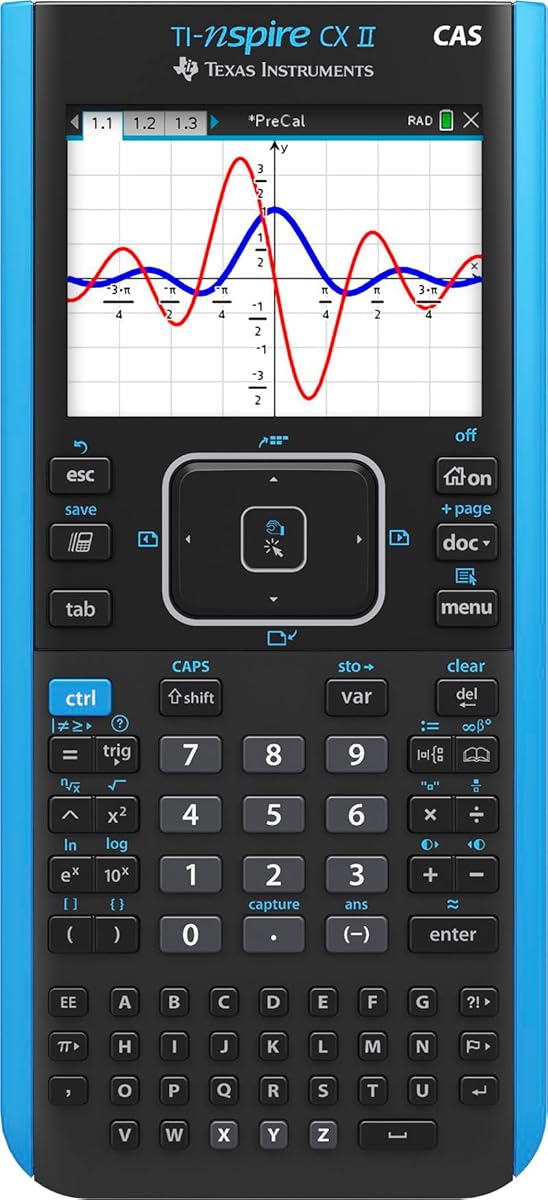
The TI-Nspire CX II CAS adds a Computer Algebra System to the CX II's features, enabling symbolic manipulation of equations. Its 4.7 rating highlights its power for university-level calculus and engineering where solving equations symbolically is required. The high-resolution color display and touchpad navigation offer a modern interface that feels intuitive and fast for exploring complex data.
We may earn a commission when you buy through this link, at no additional cost to you.
Its standout quality is the ability to perform symbolic calculus and algebra, providing exact solutions rather than approximations. This precision is crucial for advanced coursework. The included student software extends these capabilities to a desktop, ensuring continuity between homework and class work. The rechargeable battery can last up to two weeks on a single charge, ensuring reliability throughout the semester.
The price is significantly higher than other models, which may be prohibitive for casual users. The navigation system, while powerful, requires time to master compared to traditional keypad calculators. These factors are acceptable for students who need CAS capabilities to succeed in specific university or engineering programs requiring exact symbolic solutions.
We recommend this calculator for those pursuing rigorous STEM paths where algebraic manipulation is daily practice. It bridges the gap between handheld computation and computer algebra systems effectively. If your curriculum allows CAS devices, this model provides unmatched versatility for solving, factoring, and integrating complex expressions.
Solve equations with variables without needing specific numerical values, essential for theoretical math.
Two weeks of usage on a single charge ensures you never run out of power during exams or study weeks.
We may earn a commission when you buy through this link, at no additional cost to you.
The CATIGA CS-121 offers true graphing power in a familiar scientific calculator design. With a 4.4 rating, it appeals to students needing basic graphing capabilities without the premium price. Its key strength is showing the graph and formula simultaneously, allowing for quick checks of work. With over 360 functions, it covers algebra, trigonometry, and statistics effectively.
We may earn a commission when you buy through this link, at no additional cost to you.
The compact 7 by 3.3 inch body fits easily in pockets or bags, making it ideal for portable study. The protective case guards the screen and keys during travel, enhancing durability. At just 6.4 oz, it is lightweight enough for all-day use. The anti-drop housing ensures it survives occasional drops without damage.
However, the interface is less refined than established brands, which may require more effort to learn. Support and documentation are minimal compared to TI or Casio. These limitations are acceptable for users who prioritize cost and basic functionality over brand reputation. The 365-day warranty provides additional peace of mind for budget buyers.
This model is perfect for students in introductory courses or those who need a backup calculator. It provides essential tools at a fraction of the cost of premium models. We recommend the CATIGA CS-121 for students needing a functional graphing calculator on a tight budget.
View your equation alongside the graph instantly to verify solutions as you work.
Lightweight design comes with a protective case to prevent damage in backpacks or pockets.
We may earn a commission when you buy through this link, at no additional cost to you.
The CATIGA CS-229 focuses on ergonomic design with a slim profile and smooth button layout. It supports plotting functions and solving complex equations while displaying graphs and formulas simultaneously. This setup aids clear visualization of algebra and calculus problems. Its 4.4 rating indicates consistent performance for students requiring reliable basic graphing tools without spending heavily.
We may earn a commission when you buy through this link, at no additional cost to you.
Its compact size makes it comfortable for long study sessions without causing hand fatigue. The anti-drop body resists everyday impacts, ensuring longevity. The multiple modes allow adaptation to various subjects like geometry and statistics. A protective case is included to guard against damage during daily commuting or travel to campus.
The screen contrast is basic, which might affect readability in bright sunlight. Advanced statistical tools are limited compared to dedicated scientific calculators. However, for algebra and exam prep, it serves well. These trade-offs are acceptable given its affordability and design focus on portability and comfort.
This calculator suits students needing a secondary or backup device for standard coursework. It offers core functionality at an accessible price point. We recommend the CATIGA CS-229 for learners prioritizing ergonomic comfort and slim design over advanced computational capabilities.
Designed for long study sessions, the shape and button feel reduce hand fatigue during exams.
Anti-drop housing and protective case ensure the device survives daily commuting and active student life.
We may earn a commission when you buy through this link, at no additional cost to you.
The Casio Prizm FX-CG50 features a large high-resolution LCD with over 65,000 colors, providing exceptional clarity for graphing. Its 4.8 rating reflects superior visual quality and advanced capabilities. The standout feature is support for up to three 3D functions like spheres and cylinders, which is rare in handheld calculators. This makes it ideal for geometry and multivariable calculus visualization.
We may earn a commission when you buy through this link, at no additional cost to you.
It includes MicroPython integration, allowing direct coding on the device. This supports STEM curricula focusing on computational thinking. The Natural Textbook Display simplifies writing and interpreting complex math, matching textbook formats. Its approval for AP, SAT, and ACT exams ensures usability in major standardized testing environments without restrictions.
While it lacks a rechargeable battery, relying on standard power, the visual benefits often outweigh this. The unit is slightly heavier than some rivals due to its robust screen and build. These trade-offs are minor for students needing high-end visualization and 3D capabilities. Its durability ensures long-term use in demanding academic settings.
We recommend this calculator for visual learners needing detailed 3D plotting. It bridges the gap between 2D graphing and computer modeling effectively. If your coursework involves advanced geometry or calculus, the visual clarity of the FX-CG50 will significantly enhance your understanding of complex spatial relationships.
Plot complex shapes like spheres and cylinders to visualize spatial problems in multivariable calculus.
Over 65,000 colors provide sharp contrast for detailed plots and easy identification of data points.
We may earn a commission when you buy through this link, at no additional cost to you.
The TI-84 PLUS CE in Black offers the same functionality as the standard model but in a sleek design and frustration-free packaging. Its 4.7 rating confirms reliability and performance matching the flagship version. The high-resolution full-color backlit display ensures clear visibility. A key feature is the ability to import and use images, useful for geometry or graph annotations.
We may earn a commission when you buy through this link, at no additional cost to you.
It retains the familiar 84 Plus family functionality, ensuring a smooth learning curve. The rechargeable battery offers convenience, lasting up to one month on a charge. The compact form factor makes it easy to carry daily. This model is ideal for students who prefer a dark aesthetic or need the same features with specific packaging or design preferences.
It shares pricing with other color variants and does not offer significantly new features beyond the standard CE. The import capability is helpful but not critical for all users. These factors are acceptable for those who prioritize aesthetics and reliability. The robust build ensures it withstands classroom use effectively.
We recommend this for students seeking a reliable, compact color calculator with image import support. It balances design and function perfectly. If you value a sleek look without sacrificing the proven TI-84 performance, this model delivers excellent value and usability.
Import images to trace geometry or annotate graphs directly on the screen for better analysis.
Retains the standard TI-84 interface for quick adaptation without needing to learn new menus.
We may earn a commission when you buy through this link, at no additional cost to you.
Selecting the right calculator involves balancing technical features, usability, and budget to meet academic requirements effectively.
Display quality significantly impacts readability and pattern recognition. Color screens help distinguish between different functions on a graph, reducing errors during analysis. High resolution ensures clear text and equations, which is crucial for complex math. Monochrome displays are acceptable for basic tasks but may limit detailed graphing.
Battery life determines how often you need to replace or recharge. Rechargeable batteries are convenient and cost-effective over time, especially for long exams. Standard AA batteries are widely available but may need frequent replacement. Consider your usage habits to choose a power source that supports your schedule.
Many modern curricula emphasize coding literacy. Calculators supporting Python or similar languages allow you to automate calculations and solve repetitive problems efficiently. This feature prepares you for computer science requirements and data analysis tasks. Check if your course requires specific programming capabilities before purchasing.
Ensure your calculator is approved for standardized tests like the SAT, ACT, or AP exams. Restrictions often apply to specific features like wireless communication or specific models. Verify current guidelines from testing authorities to avoid issues on exam day. Most major brands list approved models on their official websites.
Faster processors handle complex calculations and graphing without delays. Memory capacity determines how many graphs or programs you can store. For data-heavy coursework, ample memory prevents the need to constantly delete files. Balance speed with your actual needs to avoid unnecessary expense.
An intuitive interface reduces the learning curve, allowing focus on math rather than navigation. Menu systems should be logical, and buttons should be well-spaced. Touchpads or icons may be faster than traditional menus but take time to master. Choose a device that matches your comfort with technology.
Calculators are frequently carried in backpacks, so durable casing is essential. Protective cases are often included or available separately. Resistance to drops and spills ensures longevity throughout your academic career. A robust build reduces replacement costs and maintenance over time.
Price varies significantly based on features. Premium models offer advanced tools that may not be necessary for introductory courses. Budget options provide essential functions at lower costs. Evaluate which features are critical for your specific needs to maximize value without overspending.
Begin by fully charging the battery if it is rechargeable. Read the user manual to understand the interface. Input basic equations to test functionality. Ensure the calculator is set to the correct mode, such as degrees or radians, for your current class.
Store the calculator in a protective case when not in use to prevent scratches and drops. Keep it away from extreme temperatures that could affect battery life. Clean the screen gently with a soft cloth to maintain visibility. Regularly backup stored programs to a computer if supported.
Update software or firmware if your device supports it to ensure compatibility with new math requirements. Participate in online forums to learn tips and tricks for specific functions. Practice daily to build confidence with navigation. Review exam guidelines before testing to ensure your device is compliant.
The Texas Instruments TI-84 Plus CE is widely regarded as the best for high school due to its balance of features and exam approval. It offers a clear color screen and intuitive interface. Most high school curriculums are designed around its functions, ensuring compatibility with classroom resources.
Yes, TI calculators offer robust build quality, extensive documentation, and strong exam approval. Their intuitive interface reduces the learning curve for students transitioning from basic scientific calculators. The investment pays off through durability and reliable performance throughout high school and college.
Most of these models, including the TI-84 Plus CE and Casio fx-9750GIII, are approved for SAT and ACT exams. However, you should always check current test guidelines, as policies can change. Ensure you disable any wireless communication features if applicable before entering the exam.
The Evo offers a faster processor, larger graphing space, and a redesigned keypad. It is newer than the Plus CE. The Plus CE remains more widely supported online. Both are excellent for STEM students, but the Evo provides a modernized interface and speed advantages.
You only need a CAS calculator if your specific college course requires symbolic algebra. For general STEM, standard graphing calculators suffice. Check your syllabus, as some university programs require CAS for higher-level calculus. Using one without need can lead to higher costs unnecessarily.
Rechargeable batteries typically last up to one month on a single charge with regular use. AA batteries may require replacement every few weeks depending on usage. Always carry a backup power source for exams. Proper usage habits help extend battery longevity significantly.
Choosing the right calculator depends on your specific academic needs and budget constraints. The TI-84 Plus CE offers unmatched versatility for most high school and college students. The Casio fx-9750GIII provides excellent value for budget-conscious learners needing reliable performance.
Prioritize features like display clarity and exam approval when making your decision. Advanced tools like CAS or 3D graphing are essential only for specific higher-level courses. Ensure the device aligns with your curriculum requirements to maximize study efficiency.
Remember that prices fluctuate regularly across online retailers. Always verify current listings and warranty details before purchasing. Select a calculator that supports your academic journey from high school through university effectively.