
OWON DGE2035 Dual-Channel Arbitrary Waveform Generator
4.2Editor score
35 MHz frequency output
14-bit resolution
PC control via USB
This guide compares the top Amfm Signal Generator options for testing and calibration. Find the perfect match for your lab or field repair needs.
Finding the right signal generator is crucial for electronics testing and repair. A good unit provides precise frequency output and reliable modulation for accurate results.
We compared ten leading models based on frequency range, modulation types, and build quality. Our analysis highlights performance, ease of use, and value for money.
Each pick shows key specs and real-world suitability. Prices vary by retailer and availability, so check current listings before making your final decision.
4.2Editor score

5.0Editor score

5.0Editor score
The following table presents a side-by-side comparison of all ten selected Amfm Signal Generator units. It highlights key specifications to help you evaluate performance and features quickly.




The UNI-T UTG962E is a standout choice for professionals needing a portable yet powerful Amfm Signal Generator. With a 60 MHz frequency range and dual channels, it delivers exceptional versatility for lab and field work. Its 5.0 rating reflects high user satisfaction regarding its accuracy and build quality.
We may earn a commission when you buy through this link, at no additional cost to you.
Key strengths include its robust modulation capabilities supporting AM, FM, and PM, which are essential for radio testing. The device includes USB connectivity for data transfer and remote control. Its compact design makes it easy to carry while maintaining high-performance specs like 200 MS/s sampling rate.
Trade-offs involve a small screen that may require closer inspection and a learning curve for advanced arbitrary waveform editing. These are acceptable given the device's high output and reliability. The included cables and adapters add immediate value upon unboxing.
Ideal for electronics enthusiasts and technicians who need a reliable, portable signal source. It balances cost and performance effectively. We recommend it for anyone prioritizing dual-channel flexibility in a handheld package.
The unit supports AM, FM, PM, and FSK modulation types ensuring versatile signal generation for various testing needs.
With a mini palm-sized form factor and light weight, it is perfect for maintenance tasks away from the lab bench.
We may earn a commission when you buy through this link, at no additional cost to you.
The OWON DGE2035 offers a cost-effective entry into dual-channel arbitrary waveform generation. With a 35 MHz range and 14-bit resolution, it serves well for educational and basic lab testing. Its 4.2 rating indicates solid reliability for general electronics work.
We may earn a commission when you buy through this link, at no additional cost to you.
Strengths include a 3.6 TFT LCD that provides clear visualization of signals. PC control via USB allows for easy automation and data logging. The inclusion of 150 built-in arbitrary waveforms saves time during setup and standard tests.
While the max frequency is lower than premium units, it is sufficient for audio and mid-frequency RF tasks. The menu system can be less intuitive for advanced users. Overall it represents excellent value for students and hobbyists.
Best suited for those needing a budget-friendly dual-channel solution. It provides essential features without unnecessary complexity. We recommend it for classroom use or entry-level engineering projects.
The 3.6 inch TFT color screen makes it easy to observe real-time waveform status and settings.
USB connectivity enables remote control for automated testing routines and integration with PC-based software.
We may earn a commission when you buy through this link, at no additional cost to you.
This 6-Band Signal Generator is designed for straightforward RF testing with a focus on reliability. Covering 100KHz to 150MHz, it supports AM and FM modulation effectively. Its robust metal casing ensures durability in workshop environments.
We may earn a commission when you buy through this link, at no additional cost to you.
Key strengths include low phase noise characteristics that improve signal purity. The simple front panel layout with clear markings makes operation intuitive. It requires no assembly, allowing immediate use upon connecting power and test clips.
It lacks a digital display and advanced waveform capabilities, which may limit complex testing. However, for basic radio maintenance and signal injection, it is highly effective. The scratch-resistant and impact-resistant build adds to its longevity.
Recommended for technicians who need a sturdy and simple RF source. It excels in environments where ruggedness is valued over digital features. It is a practical choice for standard electronic equipment maintenance.
Made with high-class metal and plastic spraying process, the unit is resistant to scratches and corrosion.
The reasonable front panel layout and convenient knobs help users get started quickly without complex setup.
We may earn a commission when you buy through this link, at no additional cost to you.
The Upgraded RF Signal Generator offers access to high frequencies up to 4400MHz. This broad range makes it useful for testing various communication equipment. Its simple design focuses on single frequency and sweep modes.
We may earn a commission when you buy through this link, at no additional cost to you.
Strengths include the ability to save parameters when power is off. It can be powered by mobile chargers or USB, adding convenience. The 3.7 rating suggests functional but limited performance compared to dedicated lab gear.
Trade-offs include a sine wave that is not strictly clean and lacks advanced modulation. It is best suited for basic frequency checks. Users should be aware of potential noise in the signal.
Recommended for hobbyists needing broad frequency coverage on a budget. It is practical for general field checks. Avoid it if high precision or clean waveforms are critical for your work.
It can be powered by a mobile charger or power bank, making it convenient for outdoor or mobile use.
Parameters are saved when power is off so the device continues at the previous frequency on power up.
We may earn a commission when you buy through this link, at no additional cost to you.
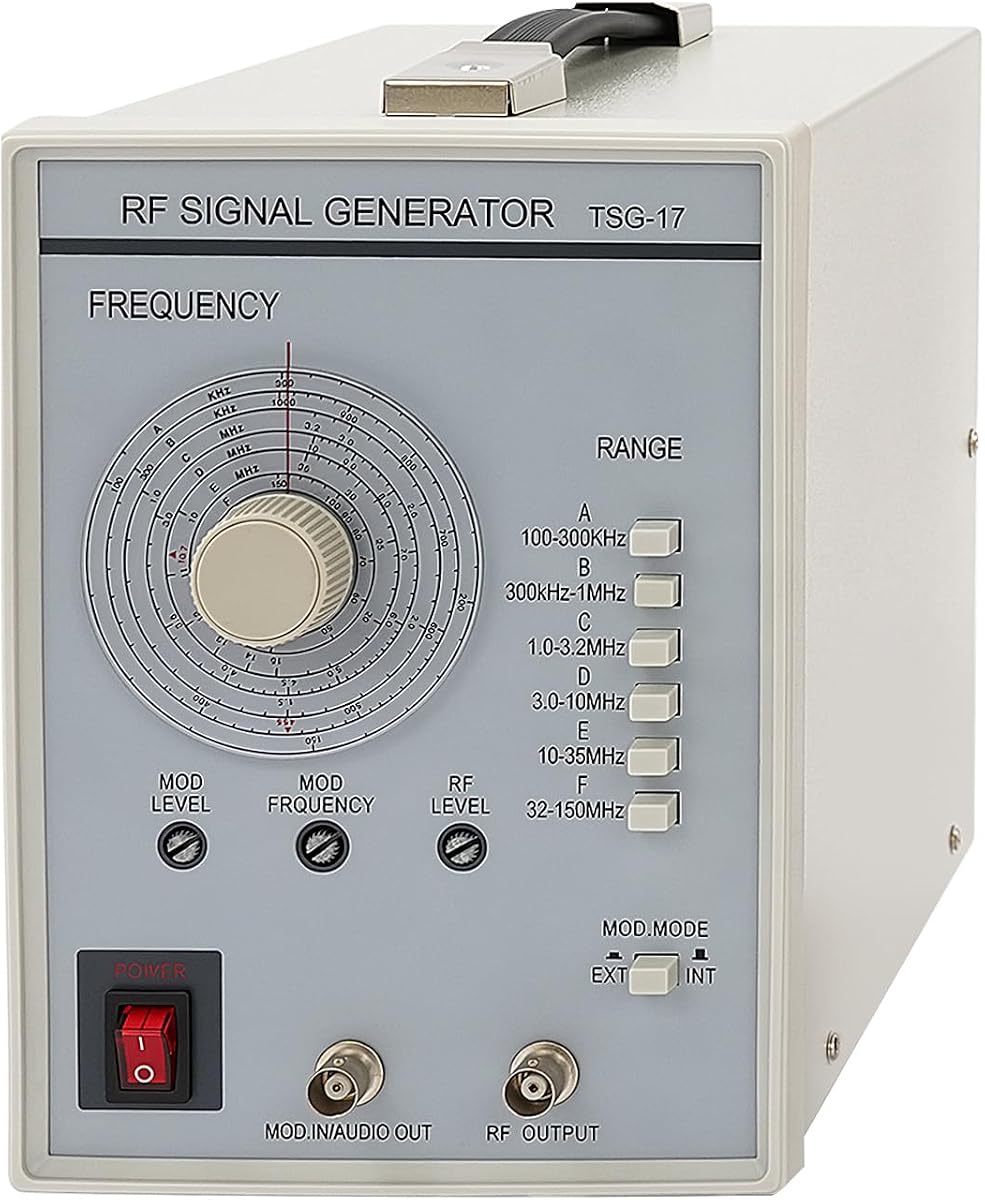
The TSG-17 is an AC powered signal generator designed for commercial and household use. It covers frequencies from 100kHz to 150MHz with high accuracy. It focuses on AM modulation and simple waveform output.
We may earn a commission when you buy through this link, at no additional cost to you.
Strengths include external modulation capabilities and a stable power supply. It is useful for basic radio testing and equipment maintenance. However, the 2.5 rating indicates potential reliability or performance issues reported by users.
Trade-offs involve limited waveform options and basic control interfaces. Users might find it less versatile than digital models. Ensure the frequency range matches your specific needs before purchasing.
Recommended for basic AC-powered testing environments. It may suit older setups that prefer analog control. Consider alternatives if advanced features or higher ratings are required.
External modulation signals can be set between 50Hz to 20 KHz allowing flexible signal testing.
The unit provides high accuracy signal generation for stable and reliable test results.
We may earn a commission when you buy through this link, at no additional cost to you.
This Adjustable Signal Generator focuses on industrial current and voltage simulation. It covers 0-12V and 4-20mA ranges ideal for PLC testing. It also includes PWM output for frequency and duty cycle control.
We may earn a commission when you buy through this link, at no additional cost to you.
Strengths include a built-in lithium battery for mobile use and short circuit protection. The ability to set output values easily makes it practical for field calibration. The 4.1 rating shows consistent performance for industrial tasks.
Trade-offs involve limited frequency modulation for RF work. It is specialized for electrical simulation rather than RF generation. The battery life depends on output load which is typical for handheld units.
Recommended for technicians working on control systems. It offers essential tools for voltage and current adjustment. Avoid if you need pure RF signal capabilities.
It supports both voltage output and current output allowing versatile testing for different industrial signals.
A 3.7V lithium battery allows use away from power outlets for up to five hours of operation.
We may earn a commission when you buy through this link, at no additional cost to you.
The Riiai 0-10V Current Generator is designed for precise industrial signal simulation. It supports 0-10V and 0-22mA with high accuracy. The 4-digit display allows detailed output verification during calibration tasks.
We may earn a commission when you buy through this link, at no additional cost to you.
Key strengths include a rechargeable battery for field use and an encoder knob for easy adjustment. It offers multiple display modes to switch between voltage and current or frequency. The 4.6 rating confirms reliable performance for PLC debugging.
Trade-offs include a limited voltage range and small screen size. These are acceptable for targeted industrial testing. The short circuit protection ensures safe operation during adjustments.
Recommended for professionals needing precise analog signal generation. It is ideal for panel debugging and device testing. Choose it for accuracy and portability in industrial settings.
Users can switch between voltage and current modes or percent and frequency displays using the mode button.
The unit features short circuit and reverse connection protection to ensure safe use during testing.
We may earn a commission when you buy through this link, at no additional cost to you.
The Riiai SG003A represents a premium option for industrial signal simulation. With a 3000mAh battery and 2.4 inch TFT color screen, it provides extended use and clear visuals. It supports current voltage and pulse signals with high precision.
We may earn a commission when you buy through this link, at no additional cost to you.
Strengths include programmable output modes and multiple signal types for versatile testing. The battery life supports up to 26 hours of work. The large screen allows easy monitoring of real-time curves.
Trade-offs involve a higher price point and weight compared to simpler models. However, the advanced features justify the cost for professionals. The preset value function enhances workflow efficiency.
Recommended for technicians needing advanced industrial tools. It suits PLC testing and maintenance tasks. Choose it for extended battery life and detailed signal control.
The 2.4 inch TFT color screen shows real-time curves and settings clearly for easier operation.
It supports programmable output modes including rise and fall cycles to automate testing sequences.
We may earn a commission when you buy through this link, at no additional cost to you.
The DROK 4-20mA Generator is a simple tool for voltage and current simulation. It uses a potentiometer for easy adjustment and supports both signals simultaneously. It is ideal for quick adjustments on PLC panels or LED testing.
We may earn a commission when you buy through this link, at no additional cost to you.
Strengths include its compact design and straightforward operation. It allows fast signal setup without complex menus. The 4.3 rating reflects satisfaction with its utility for basic calibration needs.
Trade-offs involve the lack of a digital display for precise settings. It is best suited for analog adjustments where exact numeric readouts are less critical. The simplicity ensures ease of use.
Recommended for quick field fixes and basic testing. It is a practical tool for technicians on a budget. Avoid if you require detailed digital control or displays.
A multi-cycle precise potentiometer allows for simple and handy adjustment of ampere and voltage signals.
The unit generates both current and voltage signals from one module saving space and complexity.
We may earn a commission when you buy through this link, at no additional cost to you.
The SEESII Dual Channel 30MHz generator offers top-tier performance for advanced users. With independent equal-performance channels and 14-bit resolution, it supports sophisticated circuit testing. Its 5.0 rating highlights exceptional quality and versatility.
We may earn a commission when you buy through this link, at no additional cost to you.
Strengths include seven integrated instruments in one device reducing desktop clutter. The high precision and low distortion ensure repeatable test results. The 2.4-inch TFT LCD provides clear waveform observation.
Trade-offs involve a higher cost and complexity for beginners. However, for engineering R&D and factory inspection, it delivers unmatched value. The preset arbitrary waveforms boost efficiency.
Recommended for engineers and university labs needing high accuracy. It suits both synchronous and differential circuit testing. Choose it for premium performance and feature density.
Two equal-performance channels allow independent parameter adjustment with continuous phase difference control.
It combines a function generator, pulse generator, and meter into one device saving space and cost.
We may earn a commission when you buy through this link, at no additional cost to you.
Selecting the right Amfm Signal Generator requires understanding your specific testing needs. This guide covers key factors to ensure you choose a unit that meets your performance and budget goals.
The frequency range determines the types of signals you can generate. For RF testing, ensure the unit covers up to at least 150MHz or higher depending on your needs. Lower frequency units suffice for audio or basic logic testing.
Always check the minimum and maximum frequencies to confirm compatibility with your devices.
AM and FM modulation are standard features for radio signal generation. More advanced units may support PM, FSK, or pulse width modulation for complex testing scenarios. Ensure the device supports the types you require.
Select a generator with the necessary modulation options to avoid future hardware limitations.
Dual-channel generators allow simultaneous output of different signals which is vital for comparison testing. Single-channel units are sufficient for simpler tasks. Consider if you need to test two signals at once.
Choose dual-channel for versatility and single-channel for basic applications to save cost.
Higher resolution like 14-bit ensures precise signal quality and low distortion. Accuracy specs indicate how closely the output matches the set value. For high-end labs, look for accuracy within 50ppm or better.
Prioritize higher resolution and accuracy for critical calibration work to ensure reliable results.
A clear display with intuitive controls simplifies operation. TFT color screens offer better visibility than monochrome ones. Consider if the unit supports PC connectivity for remote control.
Select a display that fits your workflow and check for USB support if automation is needed.
Sturdy construction ensures longevity especially in workshop environments. Look for metal casings and protective features like short circuit protection. Durability is crucial for portable field units.
Choose a unit with a robust build to withstand regular use and transport without damage.
Portable units often rely on built-in batteries which should offer sufficient runtime. AC powered models are stable for lab use. Check battery life if you plan to work in the field.
Ensure the power source matches your operating environment to avoid interruptions during testing.
Cost varies widely based on features. Balance price against the required specs to find the best value. Avoid overspending on unnecessary features but do not compromise on essential performance.
Set a clear budget and prioritize the features that directly impact your testing requirements.
Begin by connecting the generator to the device under test using appropriate cables such as BNC. Ensure the output impedance matches the load to prevent signal reflection. Set the frequency and amplitude according to your test requirements.
Turn on the device and select the desired modulation type. Adjust the waveform parameters like duty cycle or pulse width if needed. Monitor the output using an oscilloscope to verify signal quality before proceeding with tests.
To maintain longevity, store the unit in a dry and dust-free environment. Regularly check cables and ports for wear and replace as necessary. Keep the firmware or settings updated if the model supports PC connectivity.
An Amfm Signal Generator is used to produce electrical signals with amplitude and frequency modulation. It is essential for testing radios, audio systems, and communication equipment. Engineers use it to verify circuit performance.
Yes, many function generators support AM and FM modulation features. However, specialized units may offer higher frequency ranges and better signal purity. Check the specifications to ensure they meet your testing needs.
Select a frequency range that covers the operating bandwidth of your device. For standard RF work, 150MHz to 4GHz is common. Ensure the minimum frequency is low enough for audio or low-speed data signals.
Digital generators use DDS technology for precise frequency control and stability. Analog generators rely on oscillator circuits which may drift over time. Digital models offer more features like arbitrary waveform output.
Dual channels are helpful for comparing two signals or testing differential circuits. For simple signal injection or basic calibration, a single channel is often sufficient. Consider your specific testing scenarios.
Calibration is typically done by comparing the output to a standard reference using an oscilloscope or spectrum analyzer. Adjust internal settings to match the reference. Professional calibration services may be required for certified accuracy.
We reviewed ten top models ranging from portable handheld units to advanced dual-channel generators. The UNI-T UTG962E stands out for its balance of performance and portability making it our top pick.
Prioritize frequency range and modulation support based on your specific applications. Ensure the device has a user-friendly interface and durable build quality for long-term reliability in your environment.
Prices and availability may change so always check the latest listings before purchasing. The right Amfm Signal Generator will significantly improve your testing accuracy and efficiency.